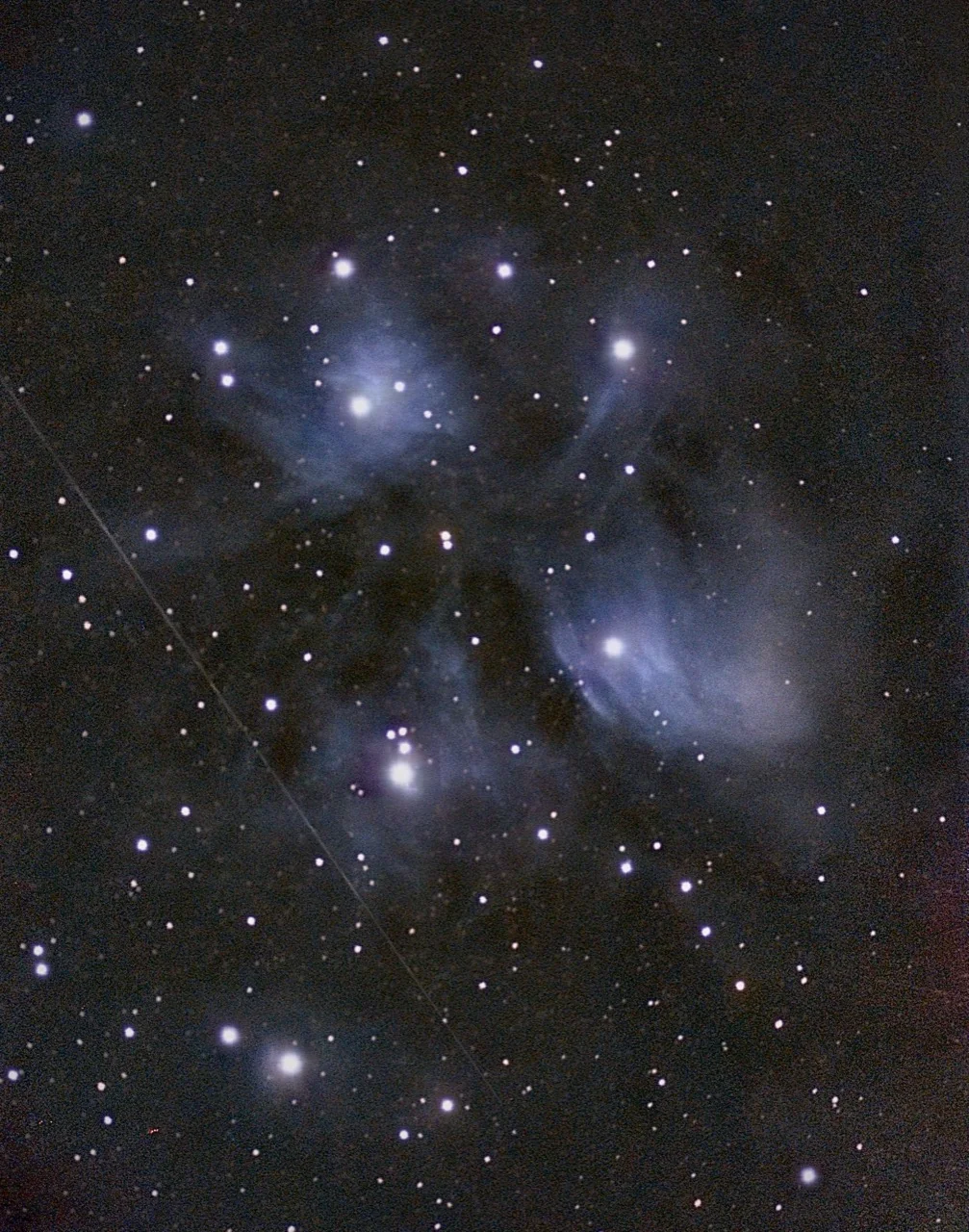
(714) Ulula, from three exposures to the scale of Portugal
A 41-kilometre asteroid caught crossing the Pleiades field on 25 July 2026, measured in three solved frames, placed on its orbit and set down over the map
(714) Ulula is a known main-belt asteroid. On the night of 24 to 25 July 2026 it crossed the sensor while the telescope was on the Pleiades, and it was recovered in all three independently solved 30-second source frames that caught it. The edited Pleiades photograph is context; the measured positions come from those three timestamped, plate-solved exposures.

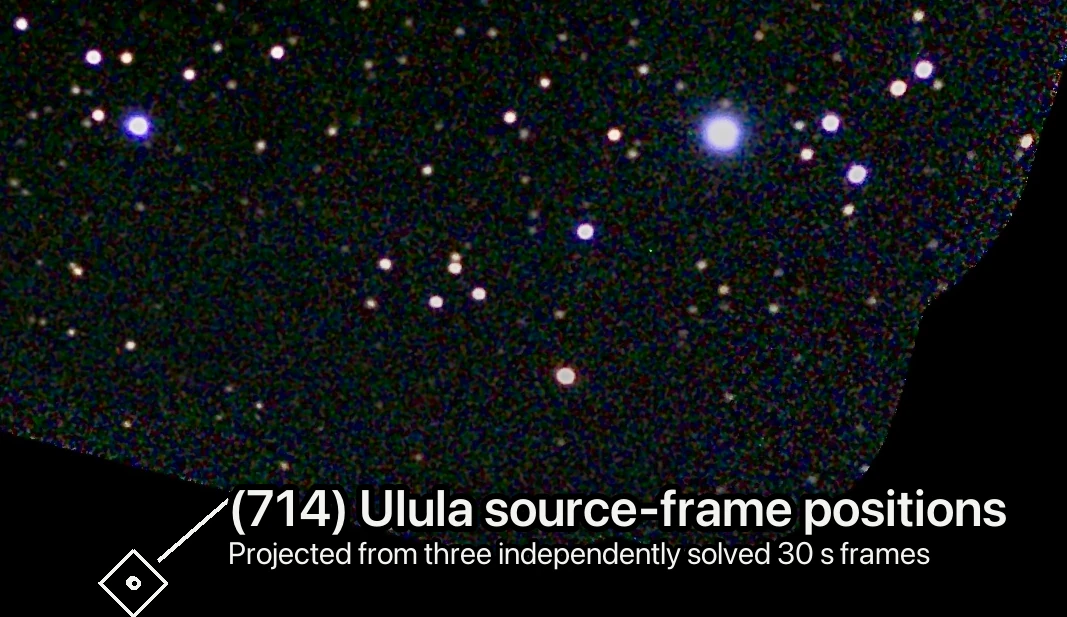
Ulula's transformed position lies at the black bottom edge of the visible mosaic footprint. The marker remains there because moving it onto the brighter Pleiades field would be scientifically false. The markers project source-frame astrometry onto the edited stack. They do not establish that the asteroid is independently visible or measurable in the edited JPEG, and the edited image is not suitable for photometry.
Three discrete samples
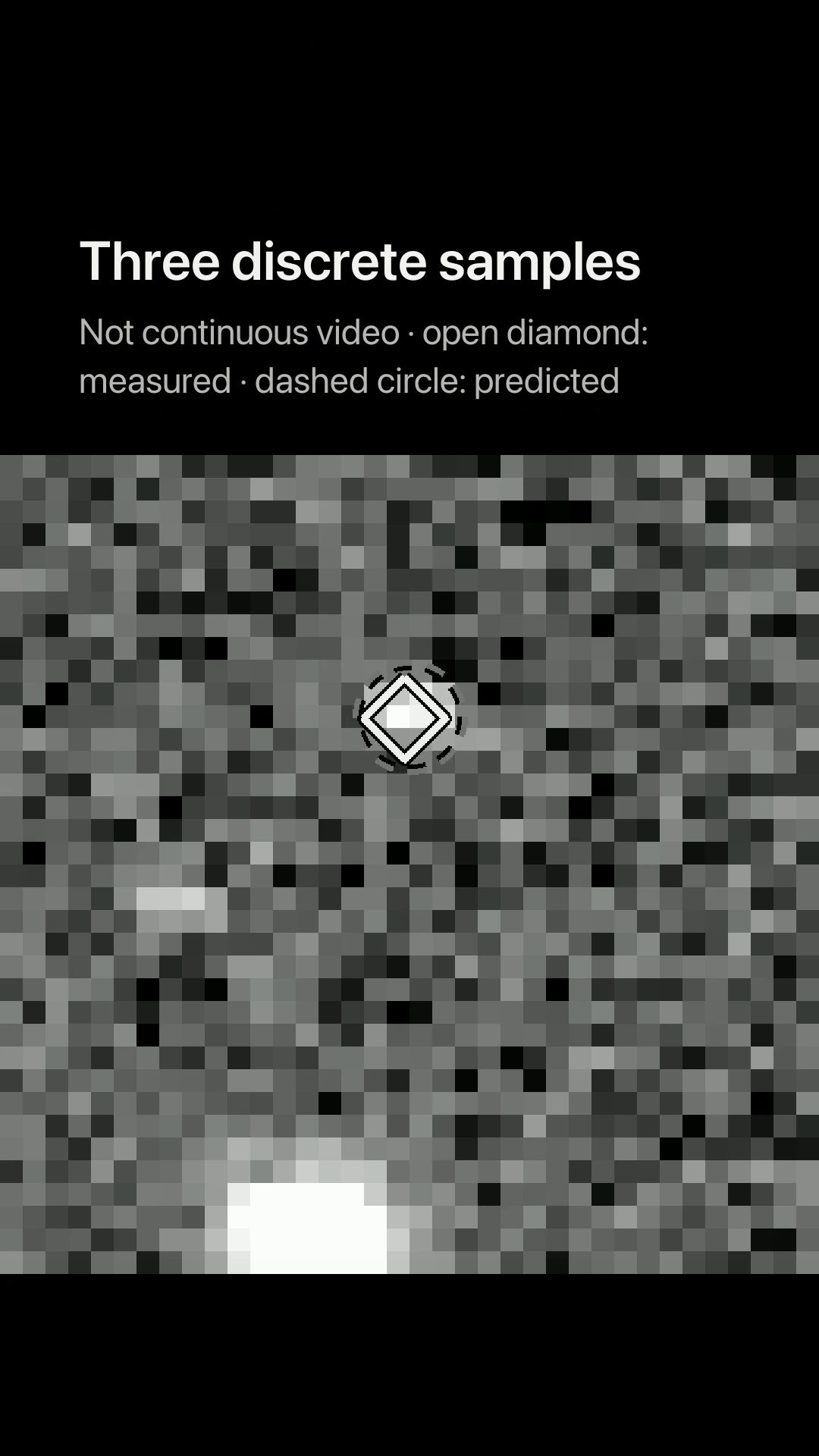
The blink compares the three solved frames after registration. Three samples are enough to confirm a known object at its predicted place: the measured source stays within 1.2 arcseconds of the prediction. The measured motion over the 5.13 minute baseline is 1.09 arcseconds per minute at position angle 77.2°, against 0.93 at 83.6° predicted. Three samples are not an orbit determination and not submission-quality astrometry.
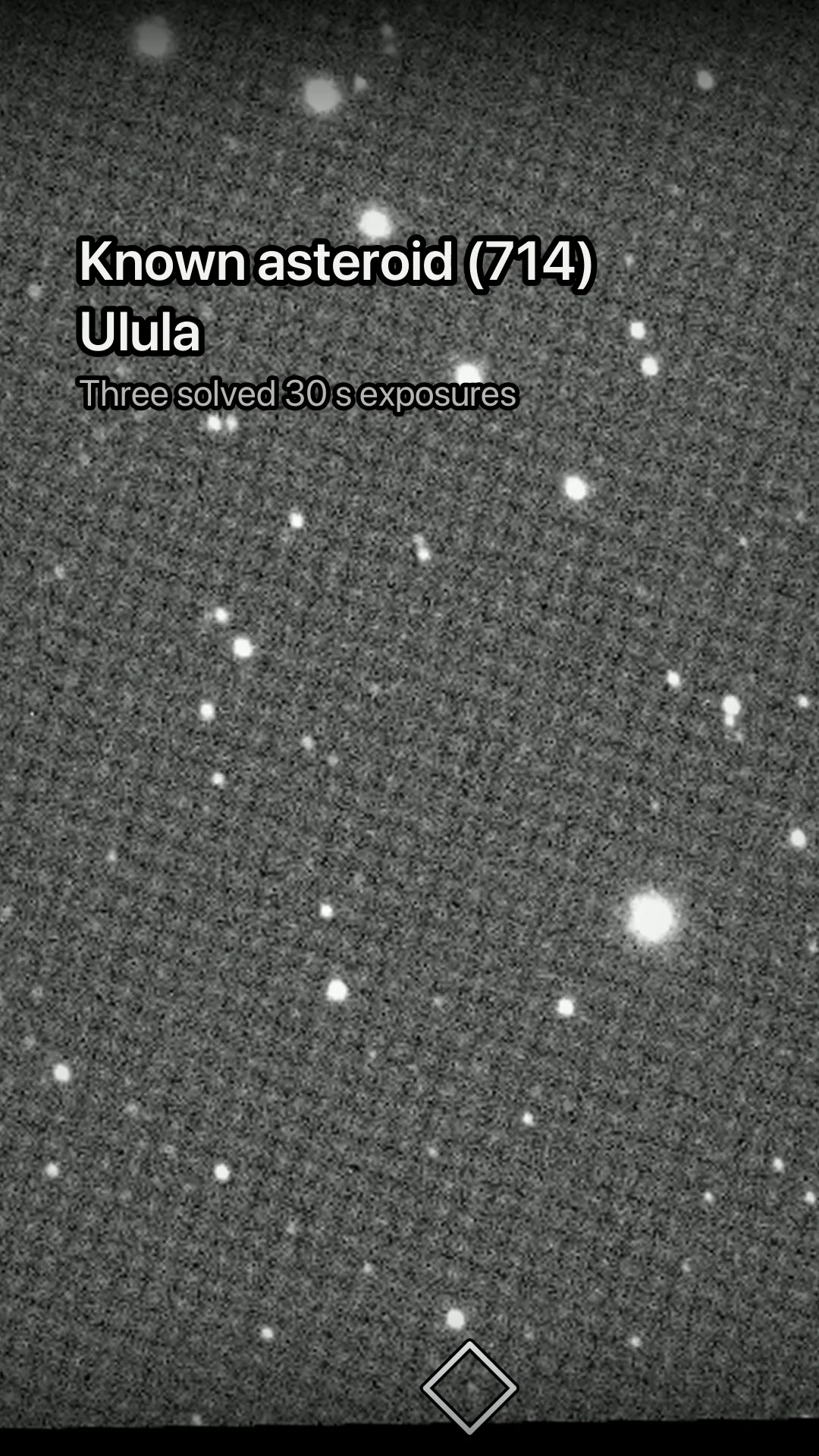
The catalogue sweep
The full Pleiades-region query is dense because the mosaic lies near the ecliptic. SkyBoT returned 1,182 known objects in the broad search circle and 904 in the initial conservative circumscribed-frame envelopes. Those are catalogue predictions, not 904 detections.
Only three predicted objects were brighter than V=16:
- (714) Ulula: verified in the actual sensor and detected.
- (359) Georgia: five independently solved candidate frames place it outside the actual sensor rectangles.
- (852) Wladilena: both candidate frames place it outside the actual sensor rectangles.
The prior long-linear-trail screen returned zero candidates. No additional uncatalogued moving-object candidate is claimed. A complete blind registered-subframe point-source tracklet search across the whole mosaic was not run, so this is not a definitive zero-result for unknown objects. Because the only measured mover matched Ulula, no targeted recent-survey archive query was needed.
The orbit at the observation epoch
The film's orbit graphic is fixed at the observation epoch; its line reveal in the film changes visibility only. It uses JPL SBDB elements with local two-body propagation for Ulula, a pinned JPL DE421 planetary ephemeris, and a biased systematic sample of 4,000 numbered main-belt objects. That sample is not a literal density or completeness map.
At the scale of Portugal
The rotating Ulula mesh is a scientific 3D model scaled to a sourced 41.343 ± 2.348 km effective-volume diameter. It is physical context, not resolved telescope imagery. Its placement over mainland Portugal is a same-scale size reference, not an impact location or prediction. Rotation in the film is time-compressed.
Films
Published from session ulula-instagram-reel-2026-07-25 · run 20260727T213401Z-publication-science-video; session user-edits-2026-07-25 · run 20260727T161745Z-ulula-edited-image-overlay; session m45-mosaic-2026-07-25-ircut-30s · run 20260726T125202Z-asteroid-search. Every number above traces to a sealed measurement in those runs.