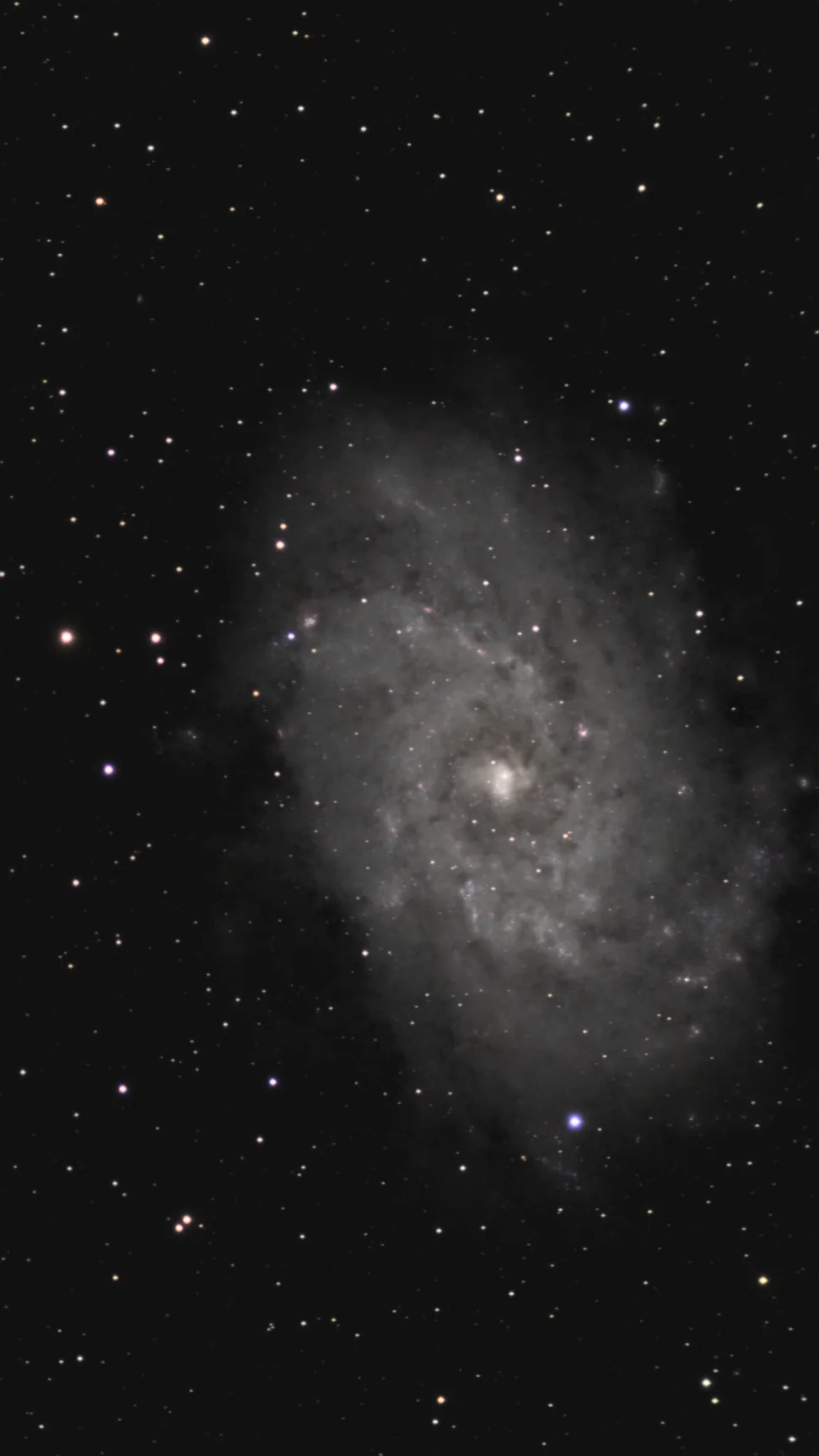
M33: what one night supports
Fifty-two minutes on the Triangulum Galaxy, 22 August 2026, and the tests that separate what the image shows from what the data prove
This report summarizes what the preserved 30-second FITS observation of M33 supports: the selected aesthetic rendition, repeatable faint structure, catalogue-position context, broadband colour consistency, and short-timescale change.
Observation and selected image

The observation contains 131 original 30-second FITS frames. The quality stack selected 104 frames, giving 52 minutes of selected exposure, while separate celestial-WCS analyses registered all 131 frames.
The selected 971 × 1726 image is a nonlinear aesthetic rendition that retains the full registered field without crop, rotation, or resampling. Galaxy-region p90 luminance changes from 0.211 to 0.361; nucleus p90/p99 remain 0.789 / 0.892 without clipping; and the reported FITS-domain background-noise sigma remains 47.7% below the original control.
The layered edit keeps stars unchanged and separately controls the neutral background, disk and core luminance, signed arms and dust, faint-arm support, a tight nucleus selector, and spatially bounded broadband colour proxies. It is not suitable for photometry. The dust selector is not a physical extinction map, and the compact H II and blue-association selectors are broadband proxies rather than physical maps. The markers drawn over the selected image are catalogue positions, not detections.
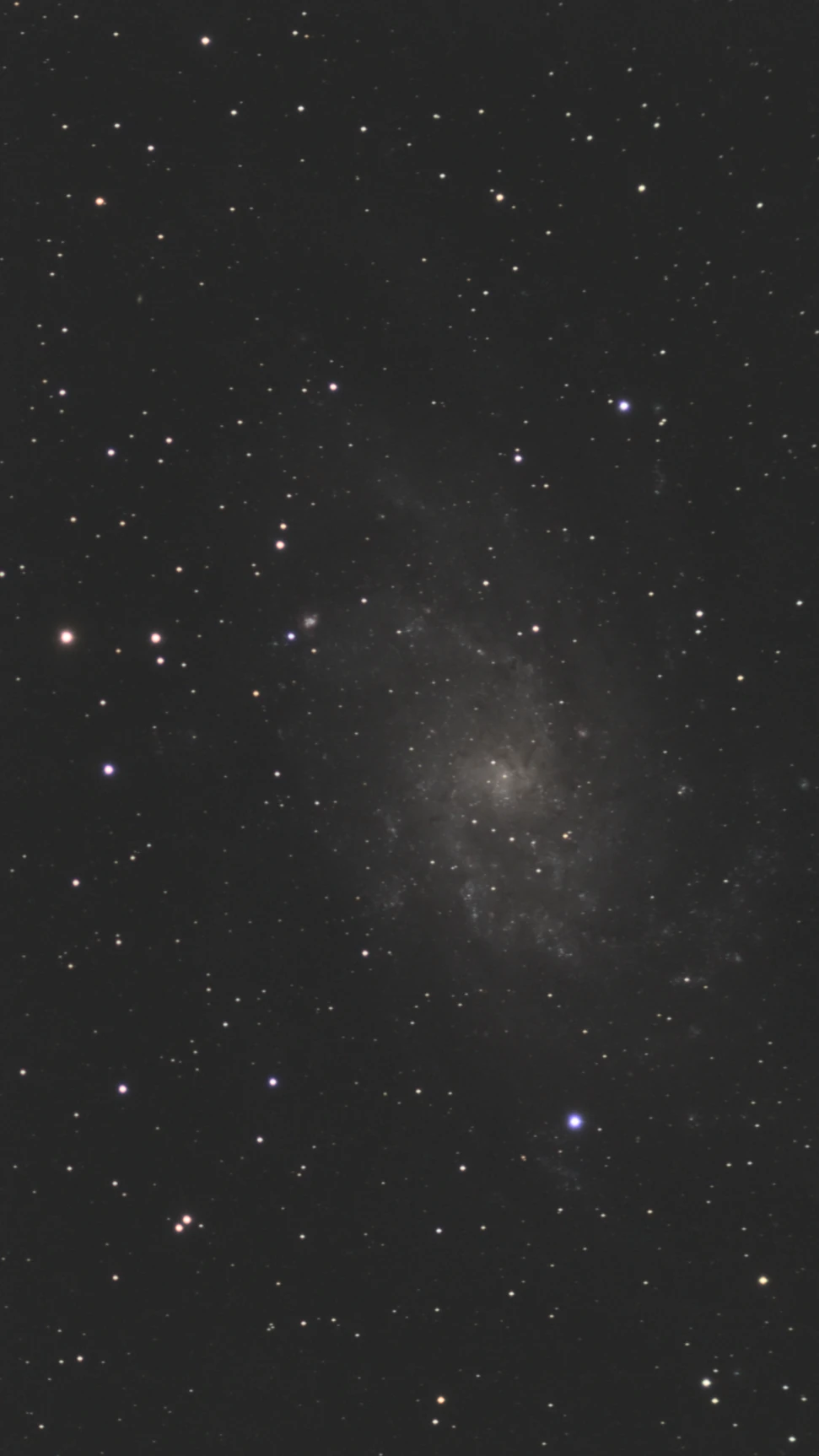
Repeatable faint structure
Independent frame splits support structure beyond a single stack realization:
- odd/even morphology correlation:
0.735; - early/late morphology correlation:
0.629; - shared repeatable support:
19.96%of tested pixels.
These support fractions are band-pass pixel evidence, not fractions of physical matter. Median splitting sacrifices sensitivity, and the minimally corrected branch controls gradients rather than providing full instrumental calibration because independent dark and flat frames are unavailable.
Catalogue-position support
Of 4,689 tested catalogue positions, 1,167 meet the pixel-support test and 649 are isolated unique positional associations. Crowded positions can share recorded light with nearby sources, so pixel support remains distinct from automatic object detection and physical classification.
The image atlas places six catalogue markers, M33, NGC 588, NGC 595, NGC 604, IC 132, and IC 133, over the byte-identical selected edit. An integer crop translation (x0 = 14 px, y0 = 42 px) maps the WCS atlas display to that edit with no scale, rotation, or warp. Validation found 714 unique stellar inliers, a 0.0185 px median residual, and a 0.1023 px 90th-percentile residual.
The transparent annotation layer is removable. Its markers are transformed catalogue-position context, not claims of new detections in this image.
The atlas behind the layers of the figure at the top projected 4,689 SIMBAD objects associated with M33 into the exact footprint: 921 H II regions, 143 supernova remnants, 205 planetary nebulae, 969 cloud and nebula objects, 1,532 clusters and cluster candidates, 918 likely stellar members and the host galaxy itself. Alongside them it placed 3,431 high-confidence foreground Gaia DR3 stars, sources with a significant positive parallax or proper motion, and 1,234 NED extragalactic rows, of which 157 are confirmed background objects by QSO class or a redshift above 0.0015, 504 are catalogue galaxies outside the M33 optical ellipse, and 571 are unknown-redshift galaxies projected on M33 that remain explicitly ambiguous. The figure shows the ones that fall inside the selected edit. Gaia inclusion does not automatically establish that a source is a visibly resolved star or an M33 member, and an angular overlap does not establish distance. No catalogue or finite exposure is complete to arbitrarily faint flux. The display stretch is context only and is not suitable for photometry. No moving-object or time-domain discovery search was part of this static catalogue-atlas run.
Broadband colour consistency
A sample of 192 isolated Gaia stars constrains the instrument's broadband response and chromatic alignment:
- red holdout residual MAD:
0.109 mag; - green holdout residual MAD:
0.095 mag; - blue holdout residual MAD:
0.137 mag; - median red-to-blue centroid offset:
0.293 px.
This is not spectrophotometry and does not justify assigning synthetic colours to M33 structures.
Short-timescale change
Across a 2.08 h baseline, zero tested stars pass the conservative rapid-variability gate. All eight recurring residual groups are detector-fixed, leaving zero unverified sky-residual hypotheses. The matching 104-frame stack has zero long-linear-feature candidates.
Ten minor bodies were predicted inside at least one exact subframe, but none is confirmed in the image data at the achieved depth. These null results remain bounded by the baseline, selection gates, stack design, individual-subframe limits, and achieved depth. They do not exclude slower, lower-amplitude, fainter, or single-subframe events outside the tested limits.
Scientific conclusion
The observation supports repeatable faint M33 structure, bounded catalogue-position associations, a constrained broadband consistency audit, and bounded null results for the tested short-timescale searches. The selected image is a scientifically documented aesthetic rendition, while quantitative claims remain tied to the sealed measurement products rather than to the nonlinear display image.
The highest-value follow-up is a deeper, independently calibrated sequence with matched darks and flats and a longer time baseline. Repeating the split-stack morphology and time-domain tests on that dataset would test which outer-arm features persist under stronger calibration and extend sensitivity to fainter or slower change.
The presentation
The report as it was published: one claim a page, made for a phone.
Published from session m33-2026-08-22-ircut-30s · run 20260825T115104Z-m33-scientific-conclusion-publication; session m33-2026-08-22-ircut-30s · run 20260824T183711Z-seestar-m33-object-catalogue-atlas. Every number above traces to a sealed measurement in those runs.