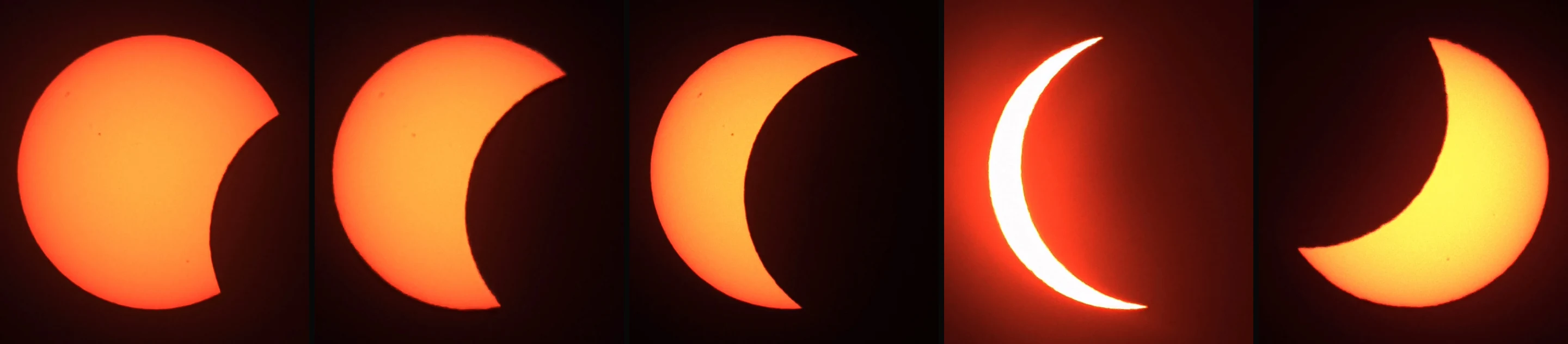
The partial solar eclipse of 12 August 2026, held still
Every recorded frame matched to the JPL ephemeris, so the Sun stays fixed and the Moon crosses it: films from the raw frames and from the camera's own timelapse, and the Moon's map projected onto the recording
Two editions of the same afternoon hold the Sun fixed while the Moon crosses it, in two different ways: one matches recorded frames to the JPL ephemeris, the other keeps every frame of the camera's own timelapse, rigidly aligned. Neither renders a model Moon or fills in astronomical pixels that were not recorded. A third draws the Moon's map onto the held-still recording.
Real frames, matched to the ephemeris
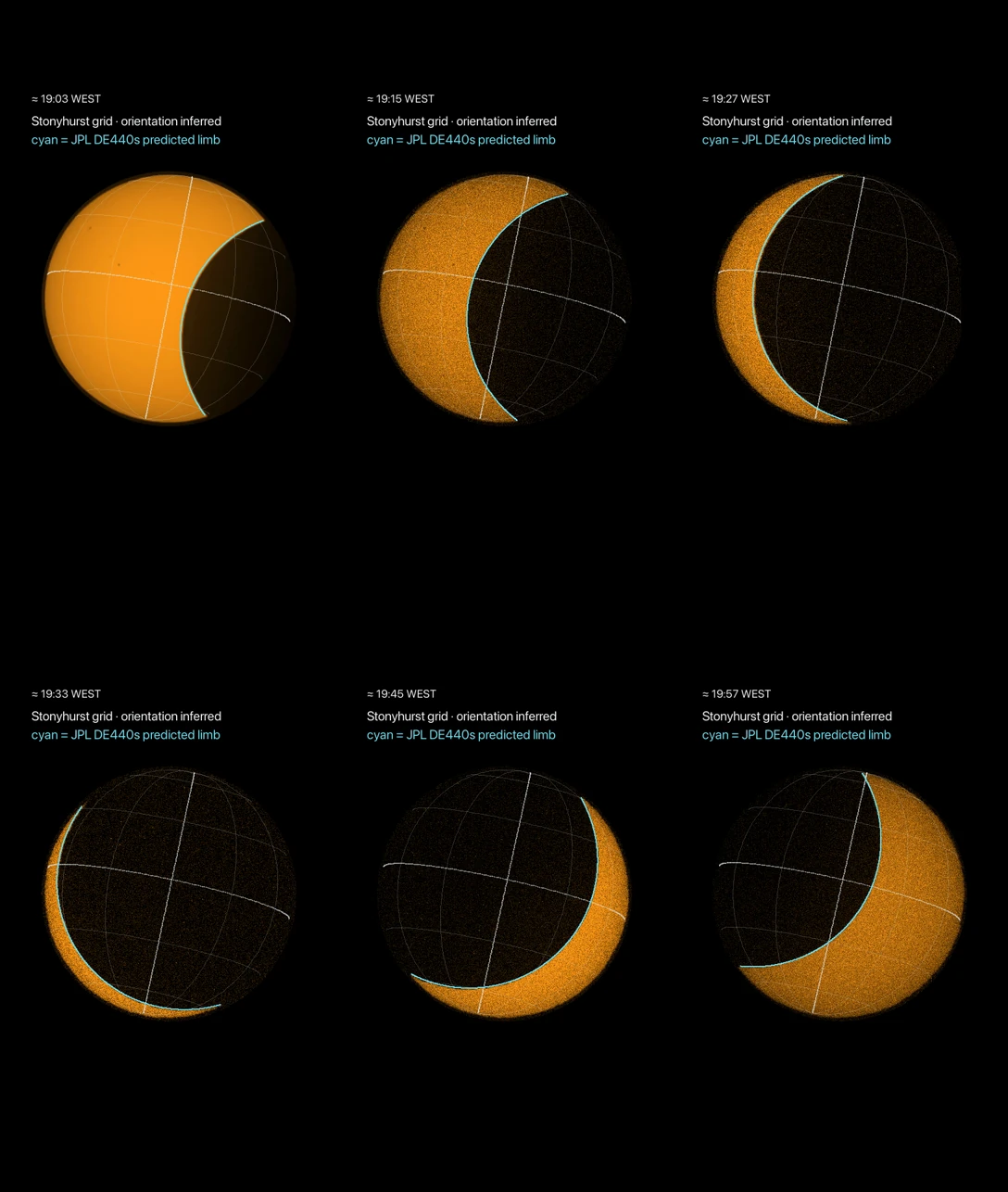
This edition matches the recorded Seestar frames to the locally evaluated JPL DE440s Sun–Moon geometry. It does not render a model Moon. Every output frame uses astronomical pixels from one recorded source frame, with solar-limb registration, a rigid rotation about the fixed Sun, false-colour tone mapping, and declared reuse where a capture is missing or rejected.
The pipeline measures the outer solar limb and the recorded lunar occultation edge in 1,729 distinct observations. It then assigns each observation to the closest monotonic eclipse phase on the DE440s timeline. A four-pixel phase agreement gate and solar-limb integrity gate reject malformed, clipped, or model-inconsistent observations. Of the 1,729 observations, 1,512 pass and all 1,512 are used at least once. For 256 of the 1,854 output frames, a valid recorded frame is used where a nearest-phase match over all 1,729 observations, rejected ones included, would have picked a different one.
The fixed solar radius is preserved: the model-match scale is exactly 1.0 in every frame. Rotation aligns the reliably measured lunar direction to the predicted direction. Near maximum eclipse, where polar angle becomes ill-conditioned, the pipeline fades repeated-frame angular advance to zero so a tiny centre displacement cannot rotate the entire recorded solar texture.
No mosaic, synthetic lunar mask, inter-frame pixel generation, or nonrigid warp is used.
At 540 × 960, the fitted recorded lunar centre differs from the prediction by 0.97 pixels median and 3.81 pixels p95. Adjacent fitted lunar-centre motion is 0.87 pixels median, 2.81 pixels p95, and 3.97 pixels p99. Rotation changes are 0.0025° median and 0.0500° p99; the scale remains exactly 1.0.
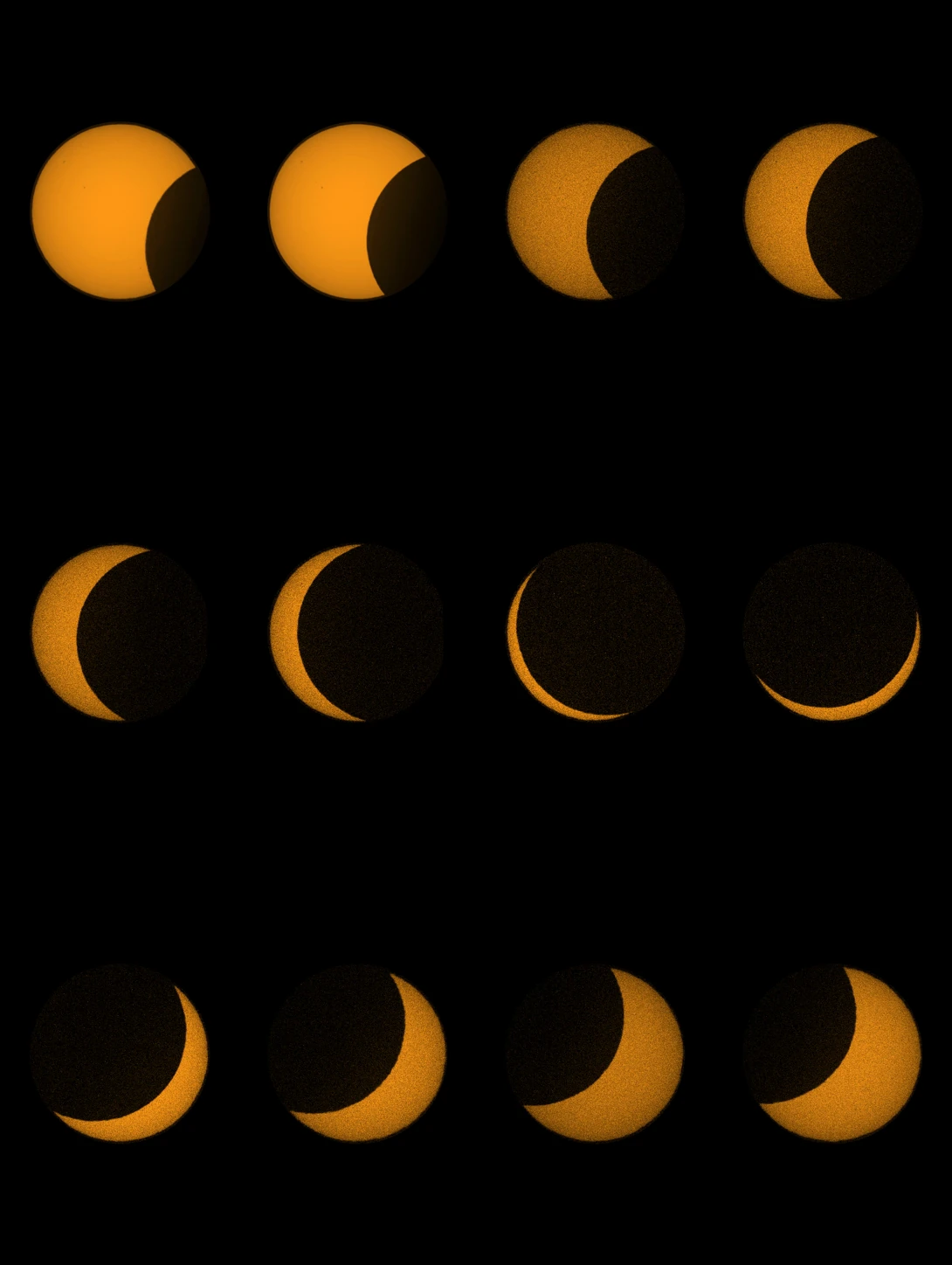
Three source-file boundaries still contain real measured phase steps of 9.13–10.87 pixels at 540 × 960. There are no valid recorded intermediate phases at those boundaries. They are left visible instead of being concealed with a reconstructed Moon, nonrigid deformation, or generated interpolation. During shorter quality or capture gaps, a valid real frame can pause before the next recorded phase while the cyan prediction continues on the ephemeris clock.
Per-frame timelapse times are inferred from source start times and adjacent capture boundaries. Solar orientation is inferred from the same-day calibration. Gold is a false-colour rendering of recorded blue-CFA signal. No dark, flat, or bias calibration frames were captured.
Every camera frame, once and in order
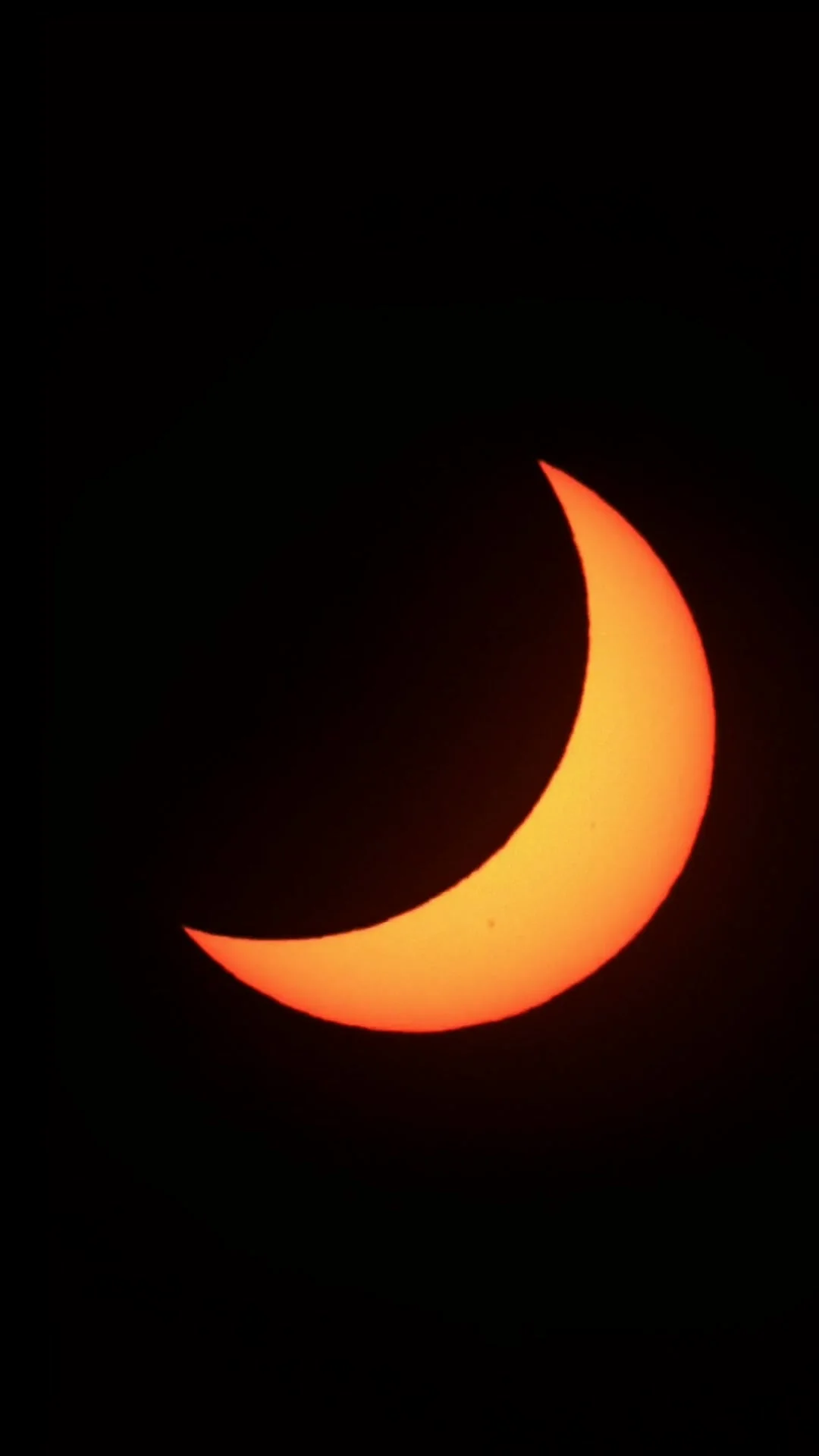
The second edition starts from the timelapse the camera generated itself and keeps every one of its 3,011 frames exactly once and in source order. It matches the complete predicted visible-photosphere shape to the complete recorded eclipse shape in each usable frame. Each frame receives only a whole-frame rotation and translation at scale 1.0. There is no stacking, frame replacement, temporal interpolation, sharpening, denoising, local warp, or synthetic astronomical fill.
The primary pose estimator performs padded phase correlation between predicted and observed eclipse edges. A normalized full-shape intensity correlation is the fallback. Rejected low-information frames receive interpolated pose parameters only; their astronomical pixels are never synthesized or blended.
At 540 × 960 preview resolution:
- solar-limb median absolute offset: 0.5 px;
- solar-limb p95 median absolute offset: 1.5 px;
- lunar-limb median absolute offset: 0.5 px;
- lunar-limb p95 median absolute offset: 1.0 px;
- direct edge-correlated poses: 2,991 frames;
- direct full-mask fallback poses: 2 frames;
- interpolated poses: 18 frames.
An earlier attempt at this edition had a real fault: its detector sometimes accepted the Moon's occulting arc as the Sun's outer limb, producing visibly displaced rigid placement in difficult crescents. That run was superseded. An independent reviewer confirmed that the prior large offsets are repaired on readable evidence, including frames 1341, 1347, 1735, 1806, 1854, 2975, and 2977.
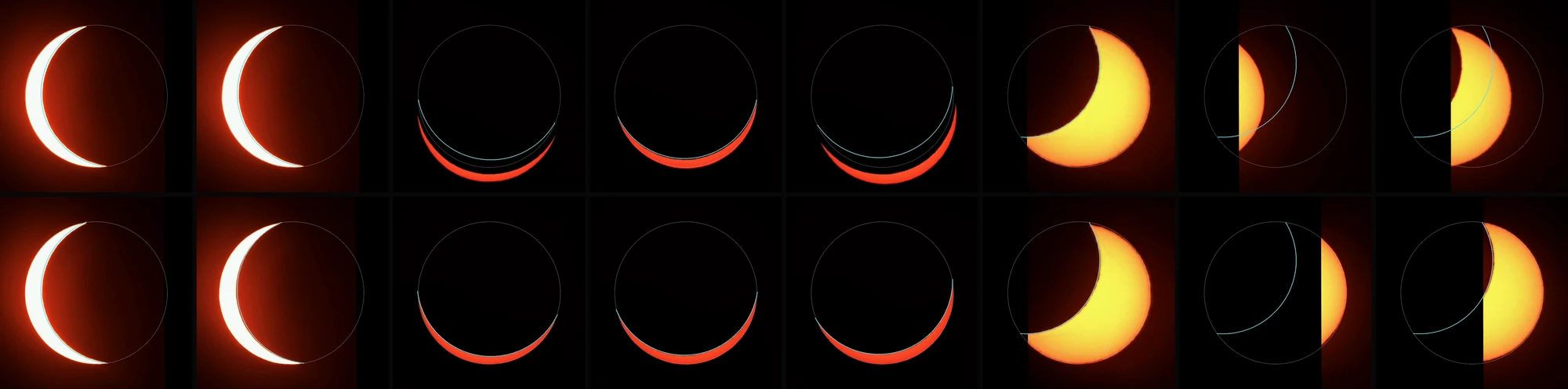
Some recorded-data failures are kept, deliberately, because this edition uses every recorded frame once and generates no replacements. These are not successful registration measurements:
- frame 418: one-frame camera blackout;
- frames 1637–1653: a blown-out, near-blank, or severely saturated Seestar burst;
- frame 2976: missing or cropped recorded coverage prevents a lunar-limb measurement.
Real gaps between clips also remain as hard jumps.
The Moon's map over the recorded Moon
The third edition starts from that corrected complete-frame film and draws thin line work over it, frame by frame. On the Sun it draws a white orthographic Stonyhurst grid, with solar north from the IAU J2000 solar pole projected into the local topocentric detector frame, hidden wherever the predicted lunar disc covers it. On the Moon it draws a cyan orthographic selenographic grid, oriented with the JPL/NAIF MOON_ME_DE421 mean-Earth frame. It also draws the outer outlines of the lunar maria, built only from the USGS Unified Geologic Map's mare units Em, Im1 and Im2: 662 source features dissolved, simplified and filtered to 29 substantial regions, drawn unfilled. Four official IAU/USGS nomenclature centres are also used as orientation landmarks, not displayed as labels. The edition published here adds an open gold marker at the projected Apollo 11 descent-stage coordinate, 0.67408° north, 23.47297° east, which enters the frame at output frame 245, and the estimated local observation time of every frame, from 18:57:55 to 19:59:43 WEST. The underlying 3,011-frame sequence remains one-to-one and chronological. This edition performs no frame selection, repetition, stacking, temporal interpolation, sharpening, denoising, tone mapping, geometric warp, or astronomical reconstruction, and no new crop, scale, translation, or source-frame rotation.
An earlier cartographic edition read Skyfield's local horizontal axes in the wrong order and mirrored every layer; it is superseded only for cartographic orientation. The corrected projection was rendered only after an independent audit passed: four decisive frames match fixed solar-pole, lunar-pole and named-landmark references within 0.08 pixels and 0.01 degrees; at frame 1500 the projected landmarks fall in the order Oceanus Procellarum, Mare Imbrium, Mare Tranquillitatis, Mare Crisium, which catches the former east-west reflection; the solar pole position angle differs from SunPy's independent P angle by at most 0.098 degrees; and the Apollo 11 site reproduces to within 0.006 pixels.
Everything drawn is a model over aligned recorded frames. The lunar grid and mare outlines are not surface detail recovered from the Seestar movie, and they stay visible over the black lunar silhouette on purpose. The label says PROJECTED APOLLO 11 / LANDING SITE because the marker is a model-projected historic coordinate, not lunar detail resolved in the Seestar recording. The lunar frame uses DE421, because that is the frame the high-accuracy NAIF lunar orientation kernel carries, while the eclipse path was derived from DE440s; the mixed provenance is declared. The displayed clock is labelled EST. OBS TIME because the upstream instants were inferred by interpolation between recorded clip timing anchors. The clock is therefore an estimated capture timeline, not a live computer wall clock.
Limitations
- Rigid alignment requires one spatial resampling pass and a new H.264/YUV encode, so the derivatives are not pixel-identical to the inputs.
- The camera-generated timelapse may contain undocumented in-device processing.
- Saturation makes precise edge residuals less meaningful in some frames, such as frame 1347.
- A guide cannot prove registration where recorded eclipse-edge evidence is blank, saturated, or absent.
- The cartographic edition needs another H.264 decode and encode after the line work is added; the products with the Apollo 11 marker and clock necessarily add label pixels, convert colour for H.264, and re-encode.
- The USGS mare boundaries are generalised display outlines, not an albedo reconstruction or exact rims for every named feature.
- Exact observer coordinates are not published; the sites are given as the two beaches.
Films
Published from session solar-eclipse-2026-08-12-praia-de-alges · run 20260812T223523Z-solar-eclipse-ephemeris-matched-real-frames; session solar-eclipse-2026-08-12-praia-de-carcavelos · run 20260813T084638Z-solar-eclipse-forward-model-rigid-original-frames; session solar-eclipse-2026-08-12-praia-de-carcavelos · run 20260813T122012Z-solar-eclipse-apollo11-observation-time. Every number above traces to a sealed measurement in those runs.