Four nights of moving objects
25 to 28 July 2026: four known asteroids recovered where they were predicted, a comet signal found in a stack, another comet left uncertain, and six searches that found nothing
Over four nights at the end of July 2026, a small telescope followed known asteroids across the sky and then searched for fainter objects. Four known asteroids appeared where they were predicted: (714) Ulula on the 25th, crossing the Pleiades field; (3) Juno over the 25th and 26th; (18) Melpomene on the 26th; (397) Vienna on the 27th. A deeper search on the 27th produced a strong point source consistent with comet 169P/NEAT. A 160-frame stack on comet C/2024 J3 (ATLAS) gave only a weak hint that did not pass confirmation. Six other intended targets were searched and not found.
There are zero discovery claims, zero uncatalogued moving-object candidates put forward, and no external submission. Everything below is a recovery of a known object, a qualified signal, or a bounded non-detection.
25 July: Ulula and Juno
(714) Ulula was recovered in all three independently solved 30-second source frames that crossed the sensor while the telescope was on the Pleiades, 03:54–03:59 UTC. That night has its own entry.
(3) Juno, over 25–26 July, 21:47–00:31 UTC, was measured in all 134 successfully registered timestamped frames from 161 originals; the other 27 frames failed registration and remain unmeasured rather than counted as misses.
26 to 27 July: Melpomene, and a comet signal
The first sequence ran from 26 July 23:04 to 27 July 00:03 UTC. The second used selected 169P frames from 27 July 01:11 to 01:29 UTC. Together they show two different kinds of evidence: a moving track measured repeatedly, and a faint signal strengthened by combining many short exposures.
Melpomene: a track measured five times
Melpomene was detected in all 5 independently solved timestamped samples. Those samples span 58.25 minutes, long enough to measure the asteroid's movement rather than rely on a single appearance.
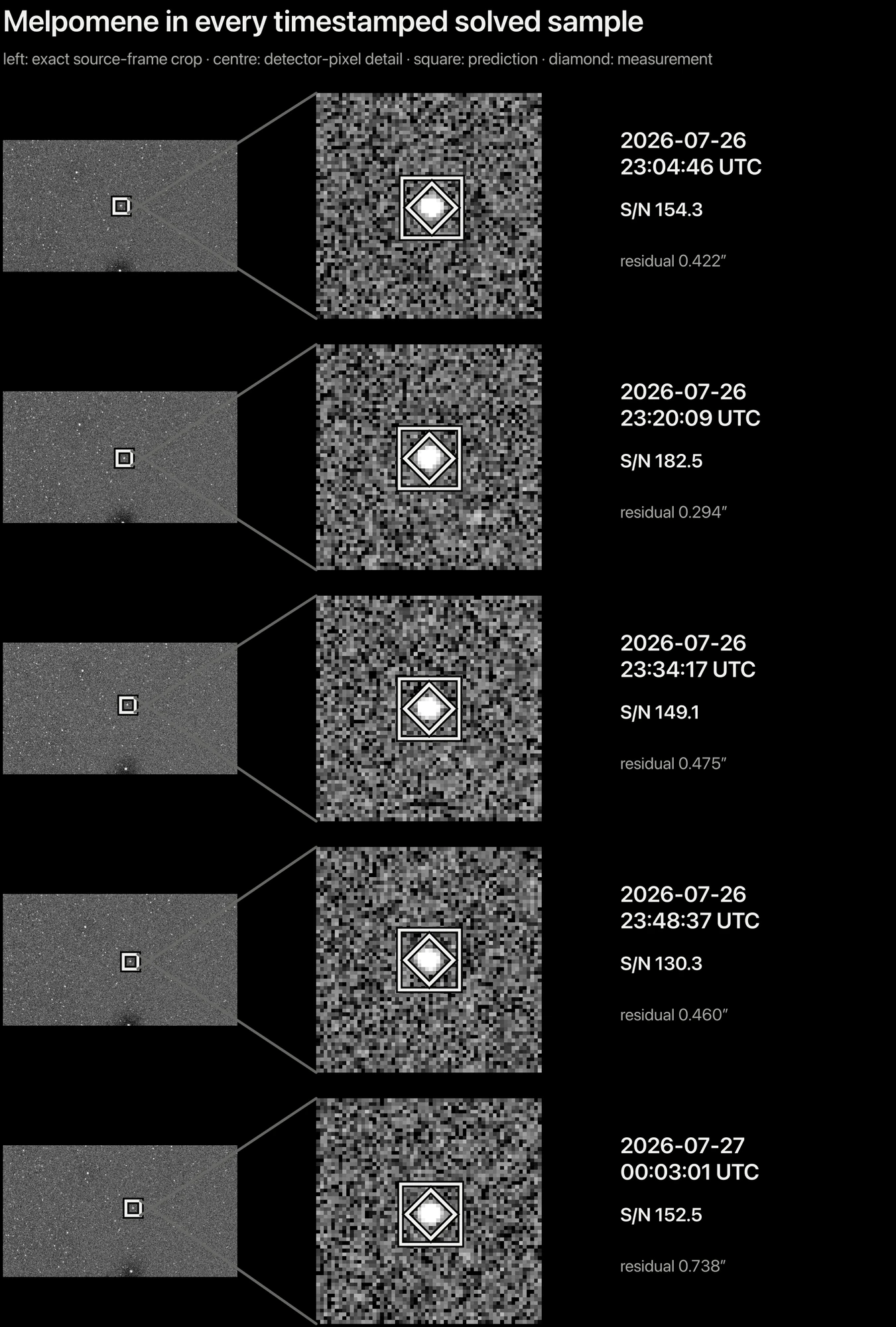
The measured sky motion was 0.641 arcseconds per minute. The predicted motion was 0.635 arcseconds per minute. Their motion-vector difference was 0.0073 arcseconds per minute, and the largest astrometric residual, the remaining separation between measured and expected position, was 0.738 arcseconds.
That agreement supports a confirmed recovery of the known asteroid (18) Melpomene. It is not a discovery claim.
169P/NEAT: a faint point source built from 43 frames
The comet search selected 43 timestamped frames, each exposed for 20 seconds, for a total of 14.3 minutes. The frames were aligned along the comet's predicted motion before being combined, allowing a faint moving source to add together while unrelated background structure behaved differently.
In the full target-centred stack, the source reached a signal-to-noise ratio of 11.98. Its measured centre lay 2.14 arcseconds from the preserved prediction. Signal-to-noise compares the strength of the measured source with the surrounding noise; higher values indicate that random background variation is less likely to explain the result.
The evidence also persisted when the frames were divided in two independent ways. Chronological thirds reached signal-to-noise ratios of 4.31, 8.25, and 8.58. An interleaved partition reached 5.29, 11.06, and 6.83. The combined result is therefore supported by different subsets of the timestamped evidence, not only by one final stack.
The strongest null path, a comparison designed not to follow the target, reached signal-to-noise 3.87. The target-centred result was substantially stronger. A further control excluded epochs when a Gaia DR3 source lay inside the measurement aperture. The full stack remained at signal-to-noise 10.10. Its Gaia-masked chronological thirds reached 2.84, 5.17, and 8.26. The first third therefore missed the predeclared signal-to-noise 3 gate by 0.16.
The conclusion is a strong known-comet-consistent point source with a visible subset caveat. The images do not resolve a coma, provide calibrated nucleus photometry, establish the nucleus diameter, or support a discovery claim.
Six searches without confirmation
The rest of the deeper search is defined by what the data did not establish:
- 2026 OA3: 120 selected frames; full-stack signal-to-noise −1.97.
- 2023 ME6: 60 selected frames; full-stack signal-to-noise −1.47.
- 2026 ND2: 59 selected frames; full-stack signal-to-noise 1.01.
- 2026 KU3: 89 selected frames; full-stack signal-to-noise 3.66.
- 2026 OA1: 59 selected frames; full-stack signal-to-noise 1.74.
- P/2021 N1 (ZTF): 44 selected frames; extended-source signal-to-noise 0.80.
2026 KU3 remains only a weak follow-up hint. Its first chronological third was absent, and its margin over the strongest null was 0.61 in signal-to-noise. None of these six targets is a detection or was put forward as a moving-object candidate.
27 to 28 July: Vienna, and a comet left uncertain
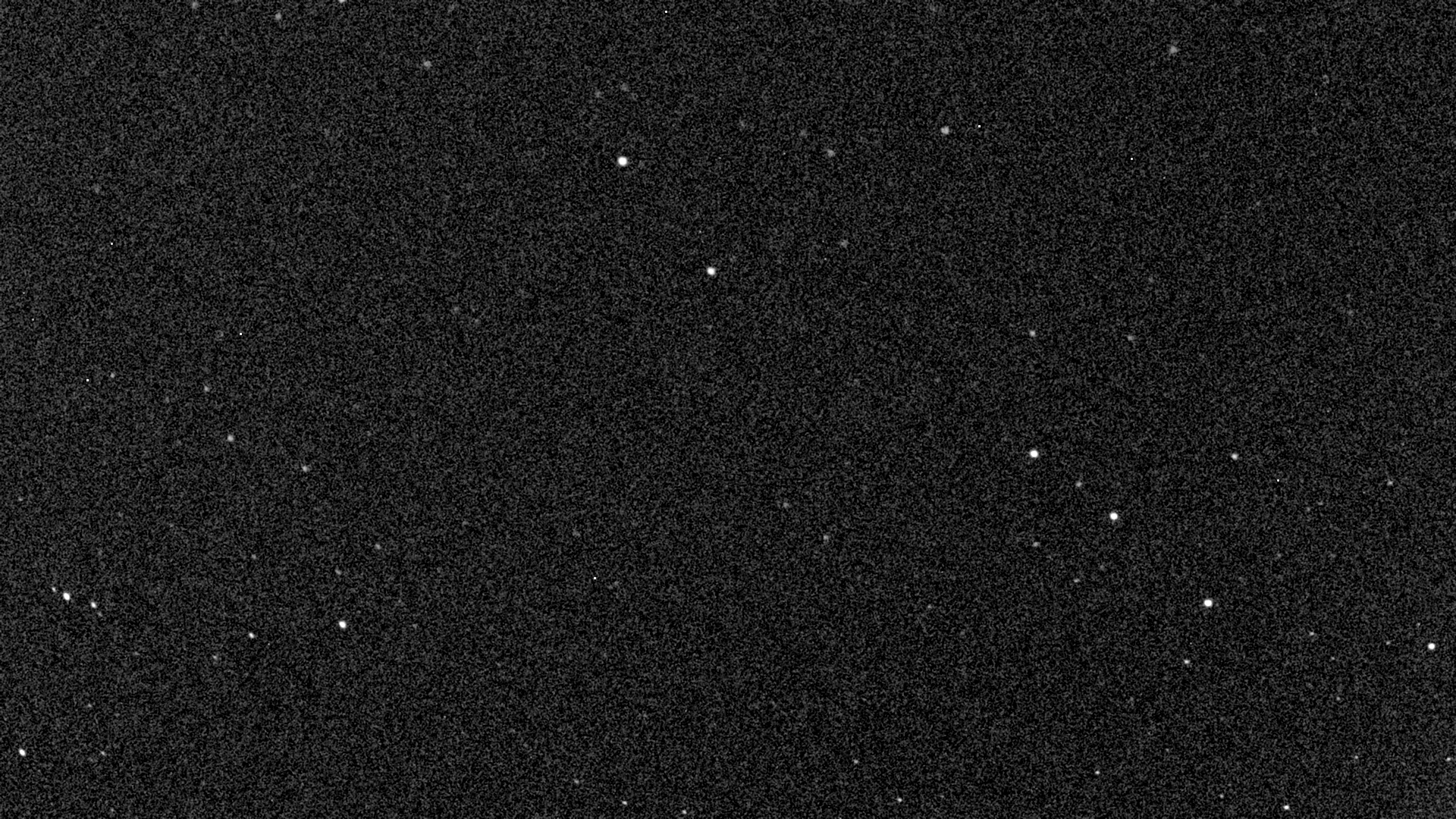
The frame at the top of this entry is frame 50 of the hundred 10-second Vienna exposures, recorded on 27 July 2026 at 23:27:37 UTC and shown with a display stretch only, no crop and no fade.
| Sequence | UTC span | Preserved frames | Exposure | Target | Result |
|---|---|---|---|---|---|
| Vienna | 27 July, 23:09:26–23:44:47 | 100/100 | 1,000 s | (397) Vienna | Recovered in 4 of 6 checked frames |
| J3 | 27 July, 23:52:39–28 July, 00:42:03 | 160/160 | 1,600 s | C/2024 J3 (ATLAS) | Signal too uncertain to claim a recovery |
Together, the two sequences preserved 260 timestamped exposures, each lasting 10 seconds: 2,600 seconds, or 43.3 minutes, of total exposure. All 260 original astronomy images remain unchanged, and their checksums match the ones recorded before analysis began. The two sequences were analysed separately, each with its own timestamps, inputs, methods, and conclusions.
Vienna appeared in four checked frames

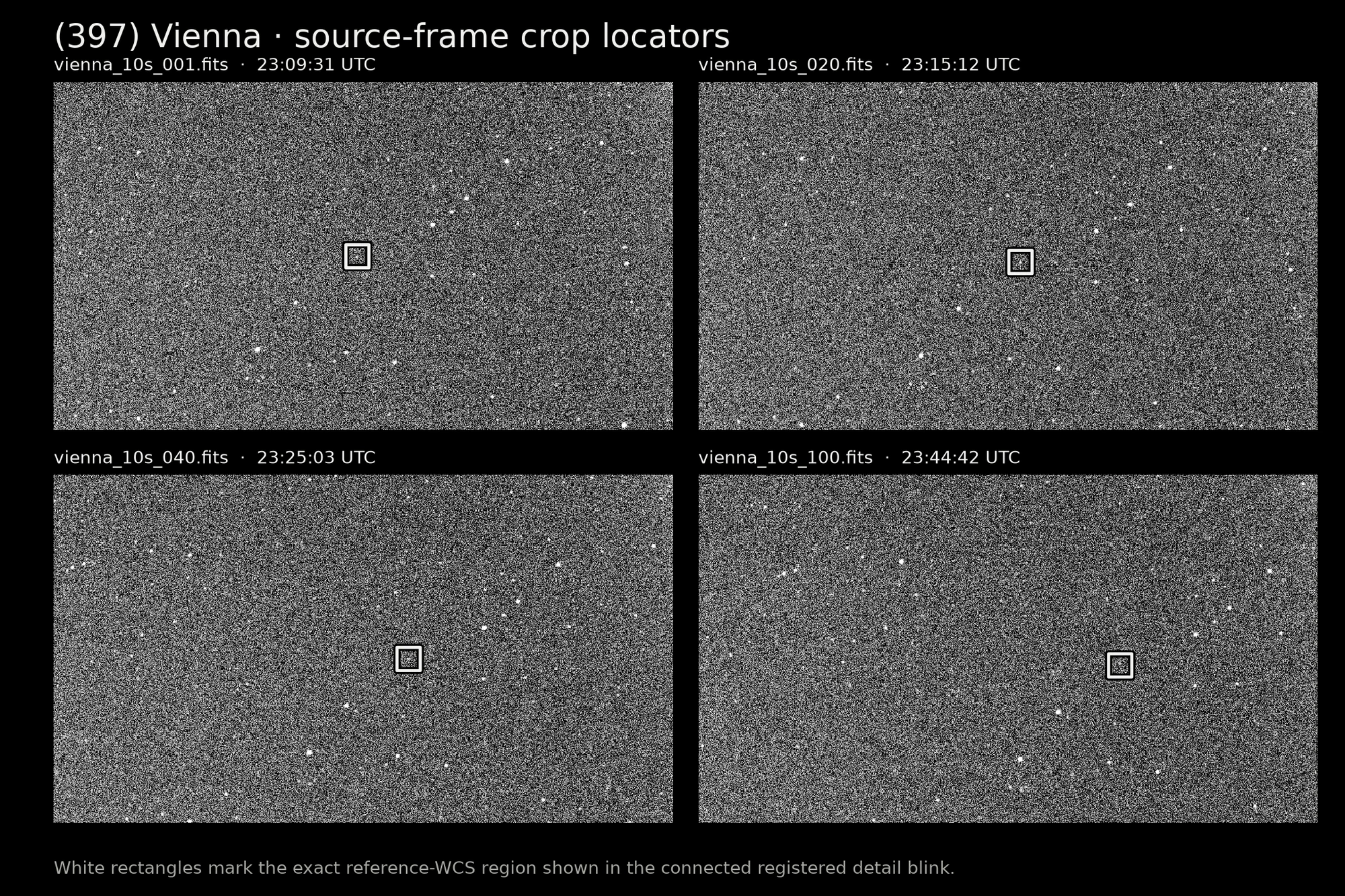
Six frames spread across the Vienna sequence were solved independently against the sky. Four contained a measurable signal close to Vienna's predicted position. A frame counted only when it passed all three tests: the signal stood at least 5 times above the measured background noise; the measured position was no more than 5 arcseconds from the prediction; and the measured motion differed from the predicted motion by no more than 0.5 arcseconds per minute.
The four accepted measurements had a signal-to-noise of 5.11–6.10, a median position difference of 2.28 arcseconds, a maximum position difference of 3.48 arcseconds, and a measured-versus-predicted motion difference of 0.102 arcseconds per minute. The remaining two checked frames fell below the signal threshold and were not counted as detections. Four accepted frames are enough for a conservative recovery of this known asteroid, but not for submission-quality astrometry.
A catalogue search found 30 known-object identities, with 26 predicted positions inside the observed field. Vienna, predicted at magnitude V 12.37, and asteroid (3977) Maxine, predicted at V 15.11, were expected inside all 100 frame boundaries. Only Vienna was recovered in the image measurements. A catalogue prediction says where an object should be; it does not show that the object was visible.
Three overlapping searches also examined 27 early, 27 middle, and 29 late frames for other consistently moving signals. Zero repeatable candidates survived. It does not rule out every possible moving object in the field.
J3 produced a weak hint that did not pass confirmation
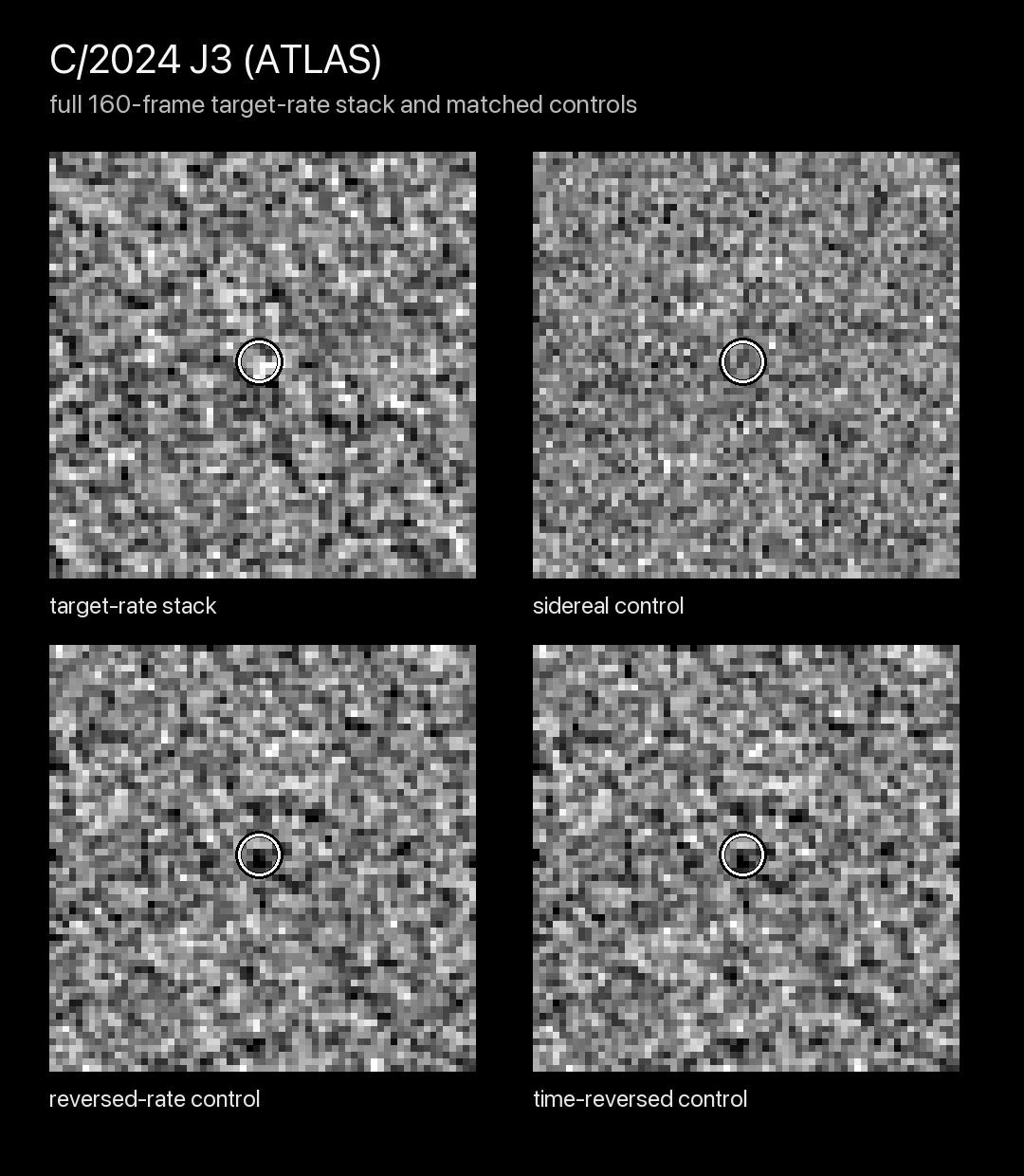
C/2024 J3 was not recovered in any of the five individually checked frames. The analysis then aligned all 160/160 frames so that an object moving at the comet's predicted rate would remain fixed before the images were combined. A point-like excess appeared near the predicted centre with a signal-to-noise of 5.91 and a position difference of 3.15 arcseconds, over 1,600 seconds of total exposure.
The position was close enough, but the signal did not pass the other confirmation tests: 5.91 was below the required signal-to-noise of 7.00; it was also below the stronger comparison-adjusted requirement of 7.257; it was only 1.65 above the strongest comparison signal, below the required margin of 3.00; and only 1 of 3 chronological sections passed their local tests.
J3 remains uncertain. A weak excess is present, but the evidence is not strong or repeatable enough to call it a recovery. This does not prove that J3 was physically absent. The analysis also produced a local 95% upper flux bound of 33.15 uncalibrated pipeline aperture units; those units are not calibrated brightness measurements, so they cannot support a magnitude or limiting-magnitude claim.
The known-object catalogue predicted J3 inside all 160 frame boundaries. Again, a prediction is not an image detection. A separate five-frame search produced five tentative software links, each based on only one frame per time group. Single-frame links can be chance associations or image artefacts, so none qualifies as a repeatable moving object. The 160-frame combination tested J3's predicted path specifically; it did not test every possible path through the field.
What outside surveys could and could not check
Public ZTF metadata contained no images covering these fields at the capture time or during the preceding 30 days. ZTF therefore could not independently check the images; this does not say that the targets were absent. An independent recent-discovery archive was unavailable, and the historical satellite file contained only seven orbital records, which were not projected against the image candidates. The satellite file therefore could not rule out every historical satellite. These missing checks are why the wider scientific status of the second night remains partial.
Where the telescope looked
The collection
The collection holds image-supported recoveries of four known asteroids, observed on separate dates. This is a cumulative collection, not a simultaneous observation.
| Asteroid | Image evidence | Displayed physical scale | Model used |
|---|---|---|---|
| (3) Juno | Measured in 134/134 successfully registered frames | 248 ± 5 km | Calibrated non-convex DAMIT model 786 |
| (18) Melpomene | Recovered in 5/5 independently solved samples | 141 ± 2 km | Calibrated non-convex DAMIT model 5911 |
| (397) Vienna | Recovered in 4/6 independently solved checkpoints | 49.0 ± 1.1 km | Literature-constrained schematic ellipsoid scaled to its sourced effective diameter |
| (714) Ulula | Recovered in 3/3 independently solved source frames that crossed the sensor | 41.3 ± 2.3 km | Uncalibrated, pole-ambiguous DAMIT model 242 scaled to its sourced effective diameter |
The shapes are size references, not predicted impact locations, and their orientations are illustrative. Juno and Melpomene use calibrated DAMIT models and Ulula an uncalibrated one scaled to its effective diameter; Vienna and 169P are schematic ellipsoids rather than shape solutions. The telescope resolved none of these shapes and measured none of these diameters.
Vienna's model needs an additional caution. It is an illustrative ellipsoid scaled to the JPL/NEOWISE effective diameter of 49.032 ± 1.055 km. Its 2017 lightcurve amplitude of 0.16 ± 0.02 magnitude supplies only a lower-limit long-to-short axis ratio of 1.159 ± 0.021 under a shape-dominated assumption; the third axis is set equal to the short axis solely for visualization. Viewing aspect, scattering, pole, concavities, and the 2026 rotational phase are unknown. This is not a shape solution, reconstructed surface, or resolved Seestar image.
169P's nucleus has a literature effective diameter of 4.6 ± 0.8 kilometres, and is in the figure above only as an illustrative ellipsoid: the telescope did not resolve it or measure its size.
Where they travel
All four recovered asteroids are main-belt objects. Each is shown on its preserved JPL orbit at its own observation epoch; for a consistent comparison the planets and a background sample of 4,000 numbered main-belt objects are propagated to 26 July 2026 at 13:42 UTC in the J2000 heliocentric ecliptic frame. The sample is catalogue-biased and must not be read as a density map, a completeness map, or image-detection evidence. These are modelled heliocentric positions, not positions measured from the images. The view does not imply that all four occupied the shown positions at one shared moment.
What the four nights established
- Four known asteroids recovered where predicted: Ulula in 3/3 source frames, Juno in 134/134 registered frames, Melpomene in 5/5 samples, Vienna in 4/6 independently checked frames.
- One strong known-comet-consistent point source, 169P/NEAT, with a visible subset caveat.
- One weak signal, C/2024 J3, too uncertain to claim a recovery; not proof of absence.
- Six intended targets unconfirmed; no repeatable additional moving-source candidate in the completed Vienna search; the broader J3 search for arbitrary moving paths remains partial.
- No new-object claim, and nothing submitted externally.
The presentation
The report as it was published: one claim a page, made for a phone.
Published from session measured-minor-bodies-2026-07-25-to-27 · run 20260727T132321Z-night-report-science-narrative-rewrite; session moving-objects-2026-07-27-to-28 · run 20260728T105850Z-science-report-publication-cumulative-asteroids. Every number above traces to a sealed measurement in those runs.