Protevs
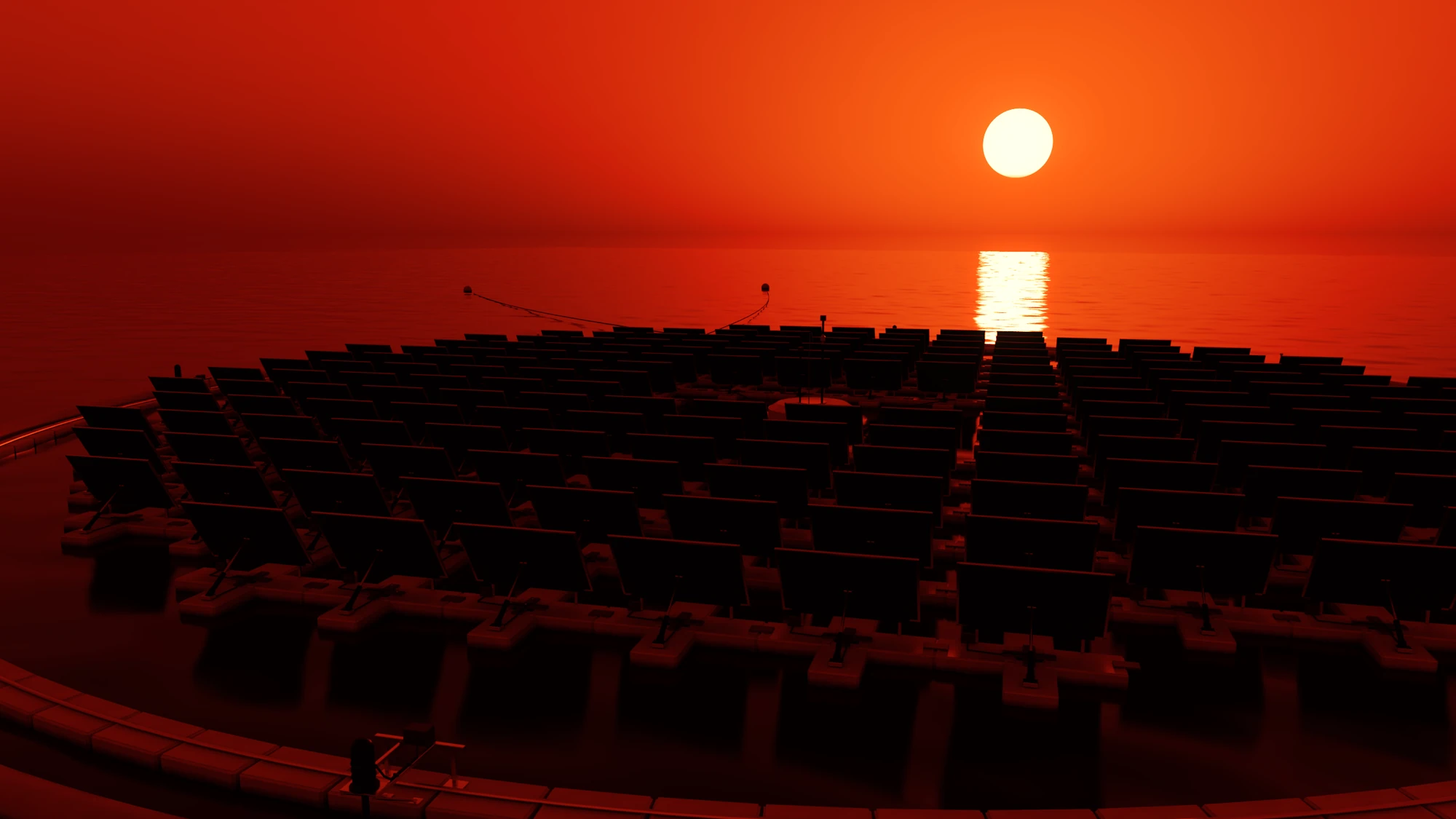
Floating solar that follows the sun
I was the concept designer of Protevs, for the University of Aveiro, and I came up with the name in a presentation to the university. SolarisFloat turned the concept into a product, engineered with INEGI.
Solar power is more efficient than ever. However, it still requires large expanses of land.
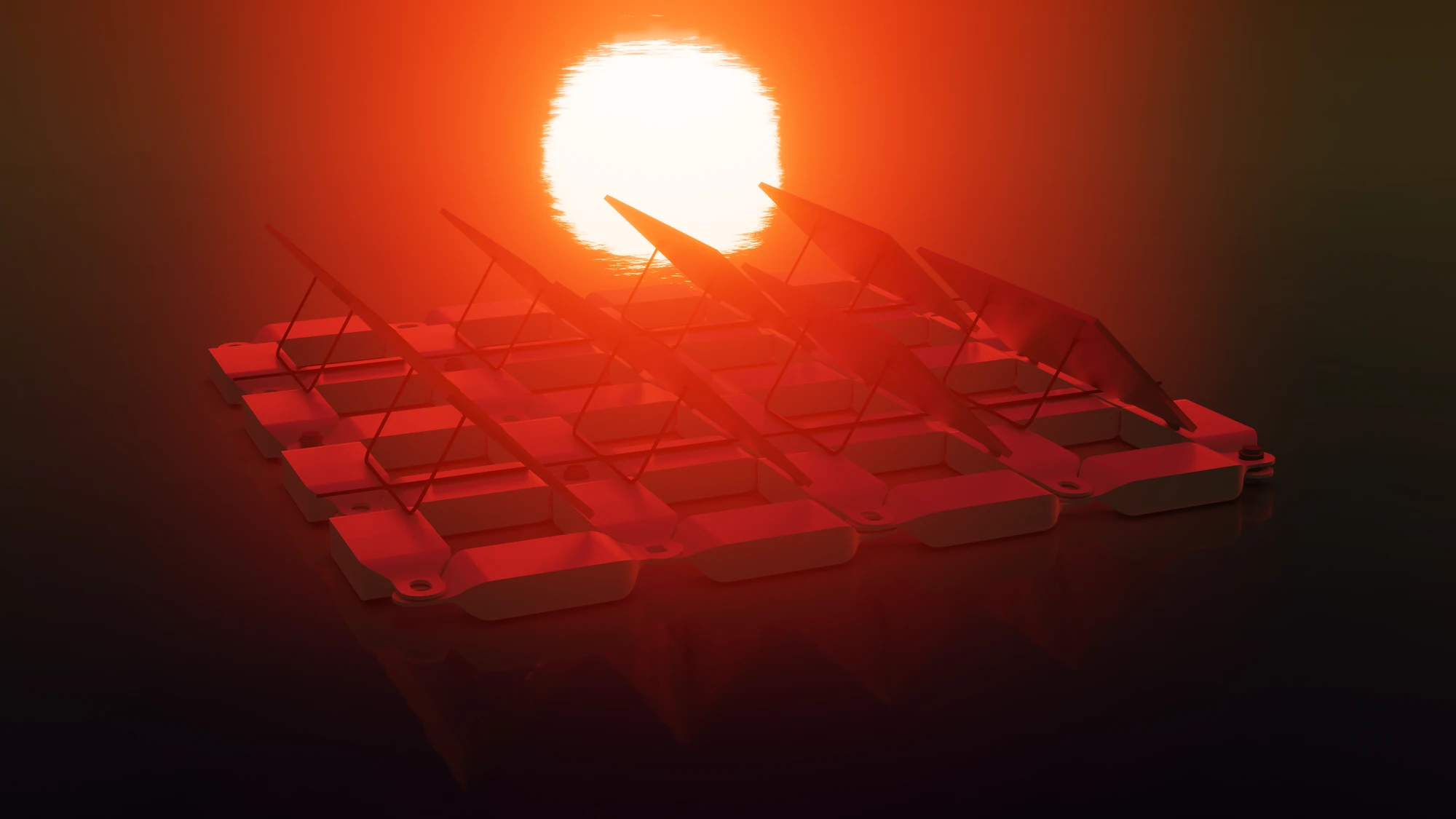
Protevs is a modular solar system that follows the sun on two axes. The panels are assembled into islands that rotate around a central axis, to face the sun's bearing, while the panels oscillate vertically, to follow its height.
The concept
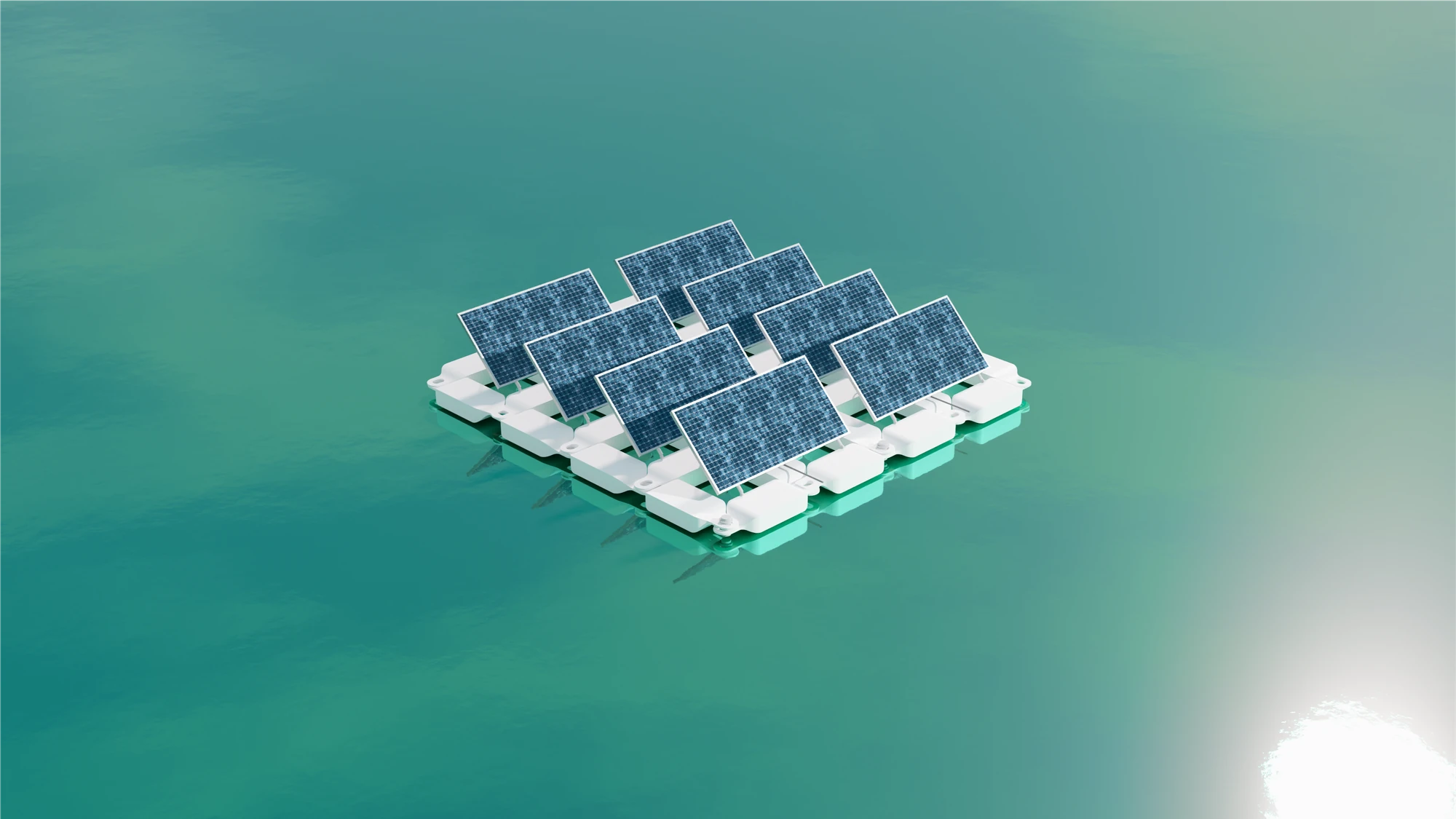
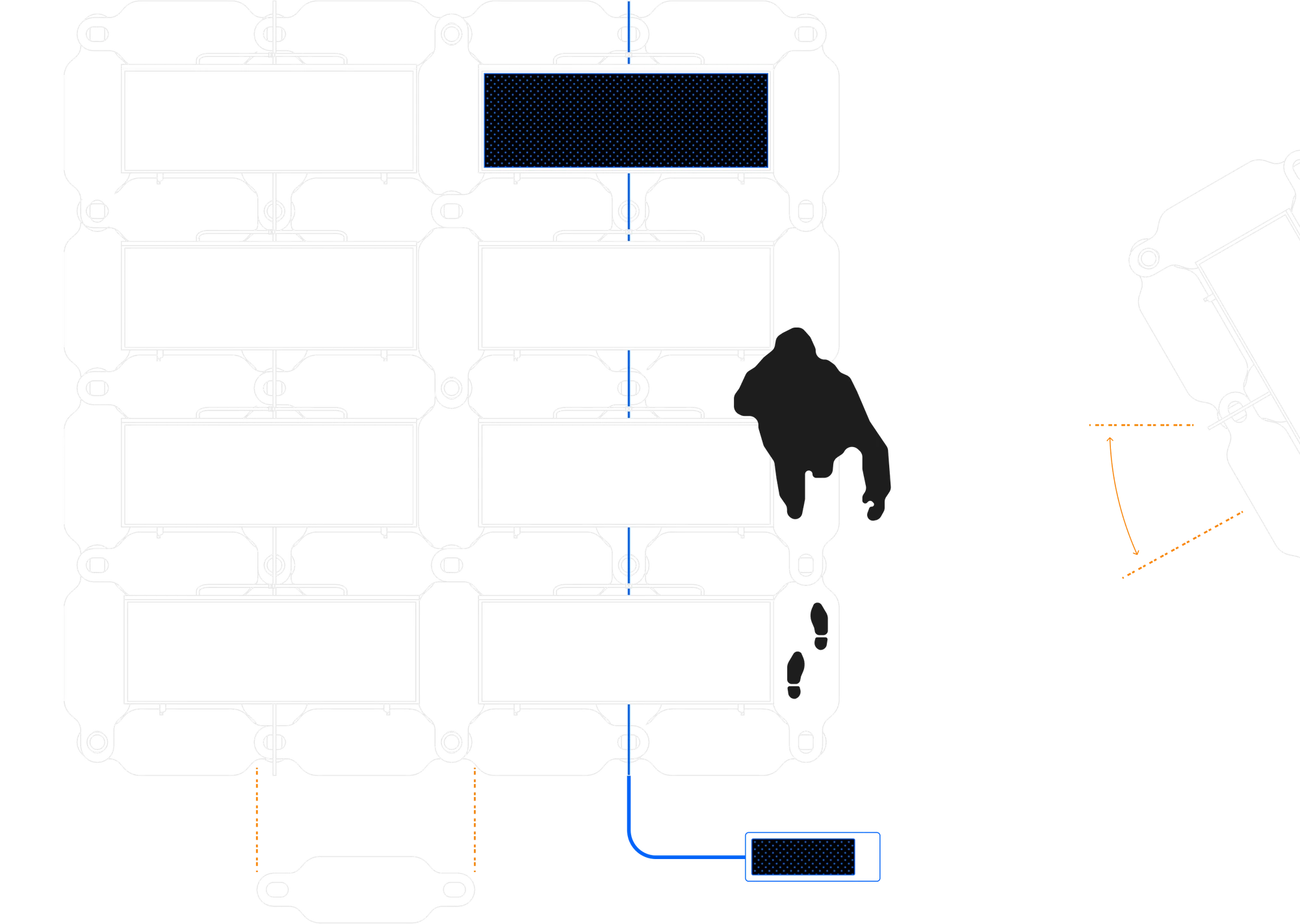
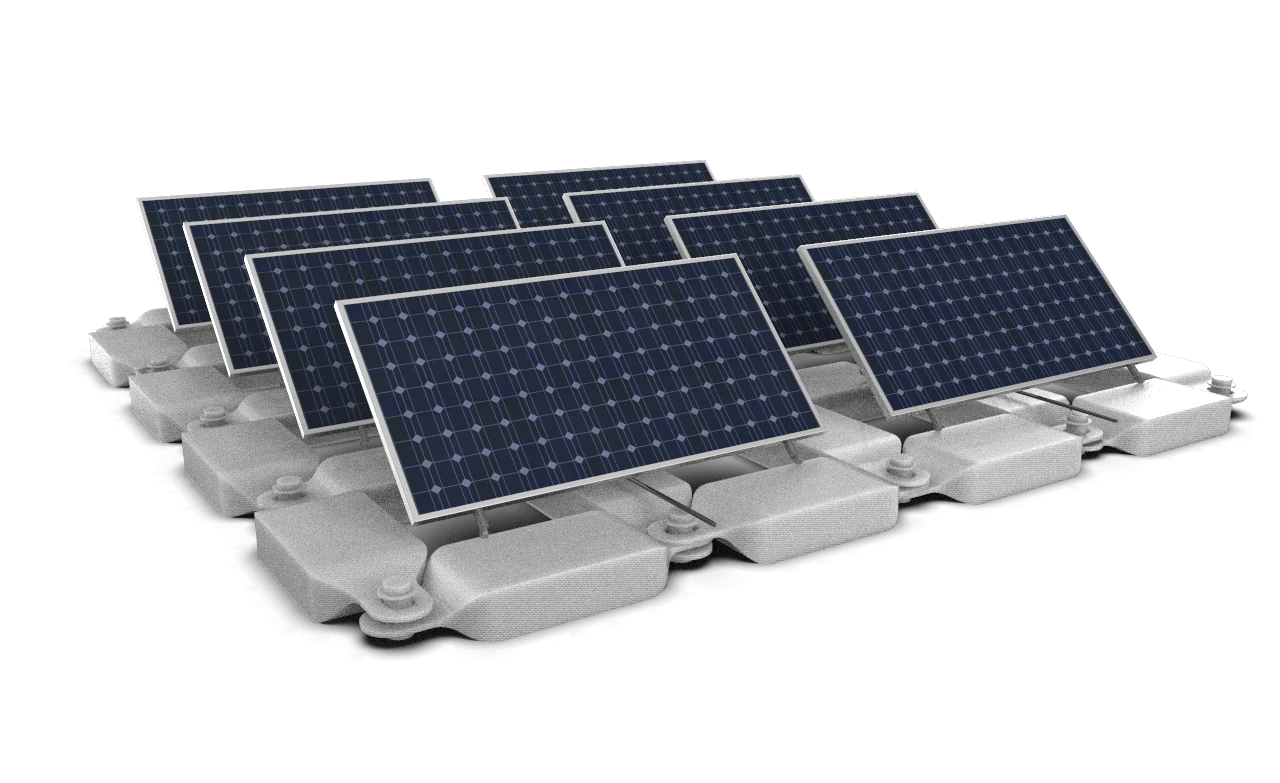
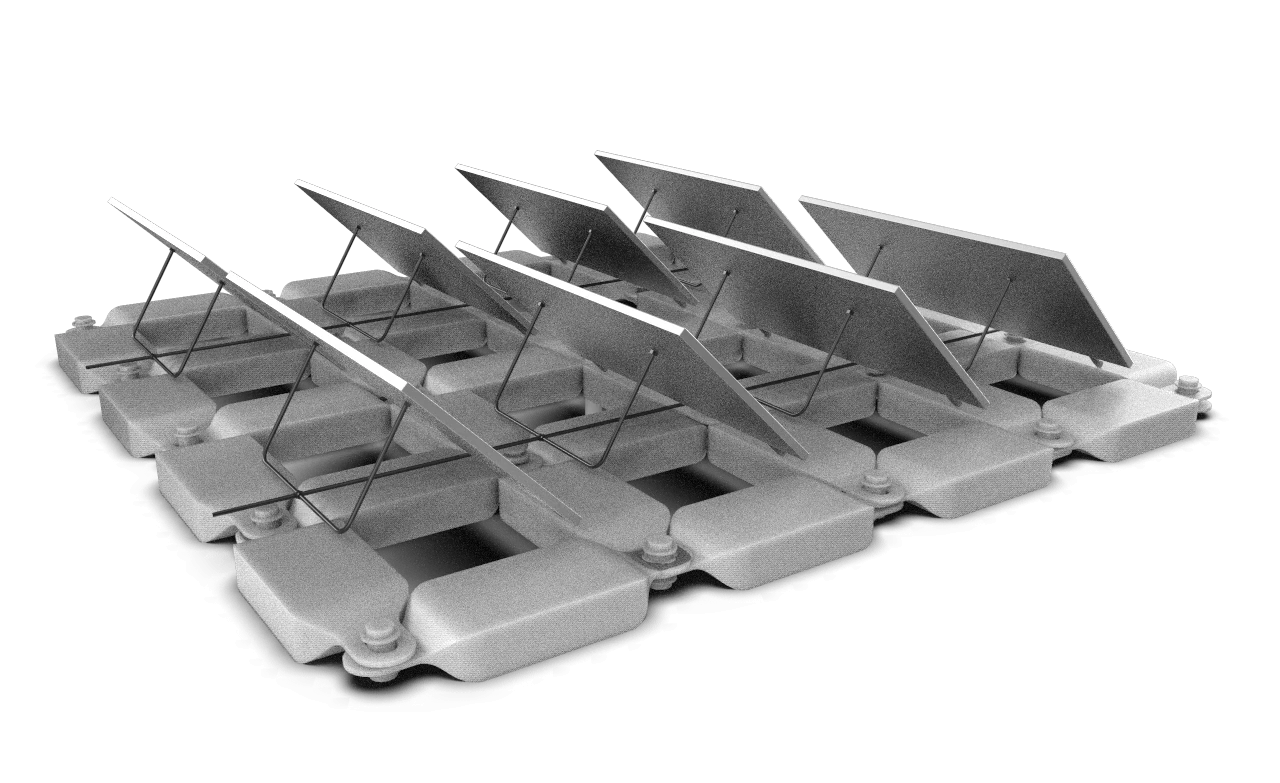
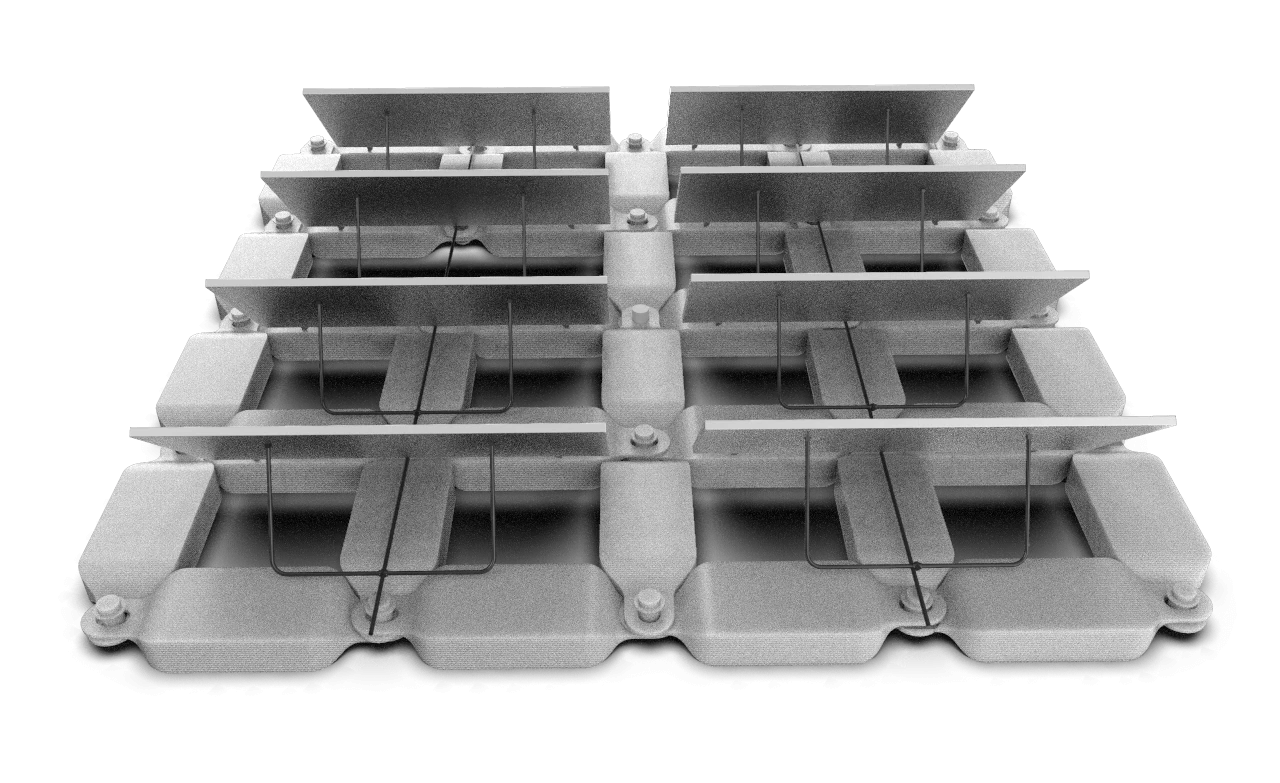
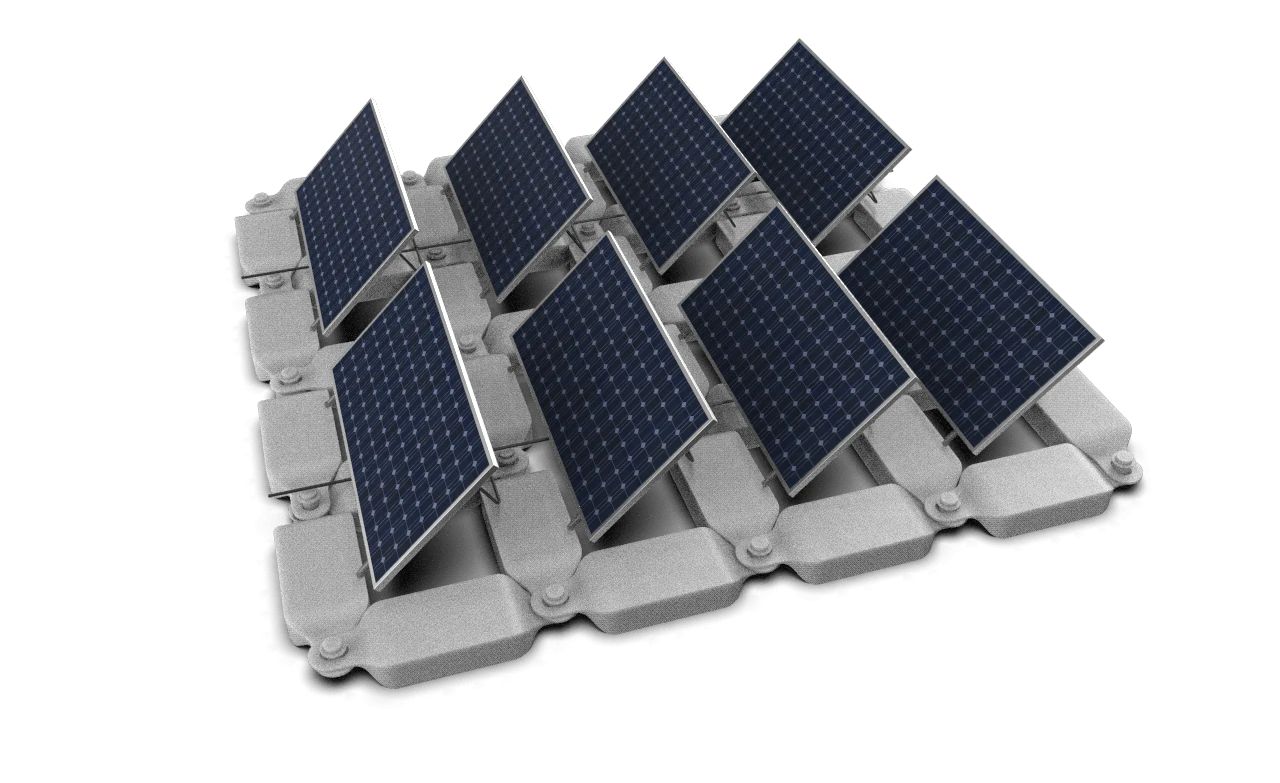
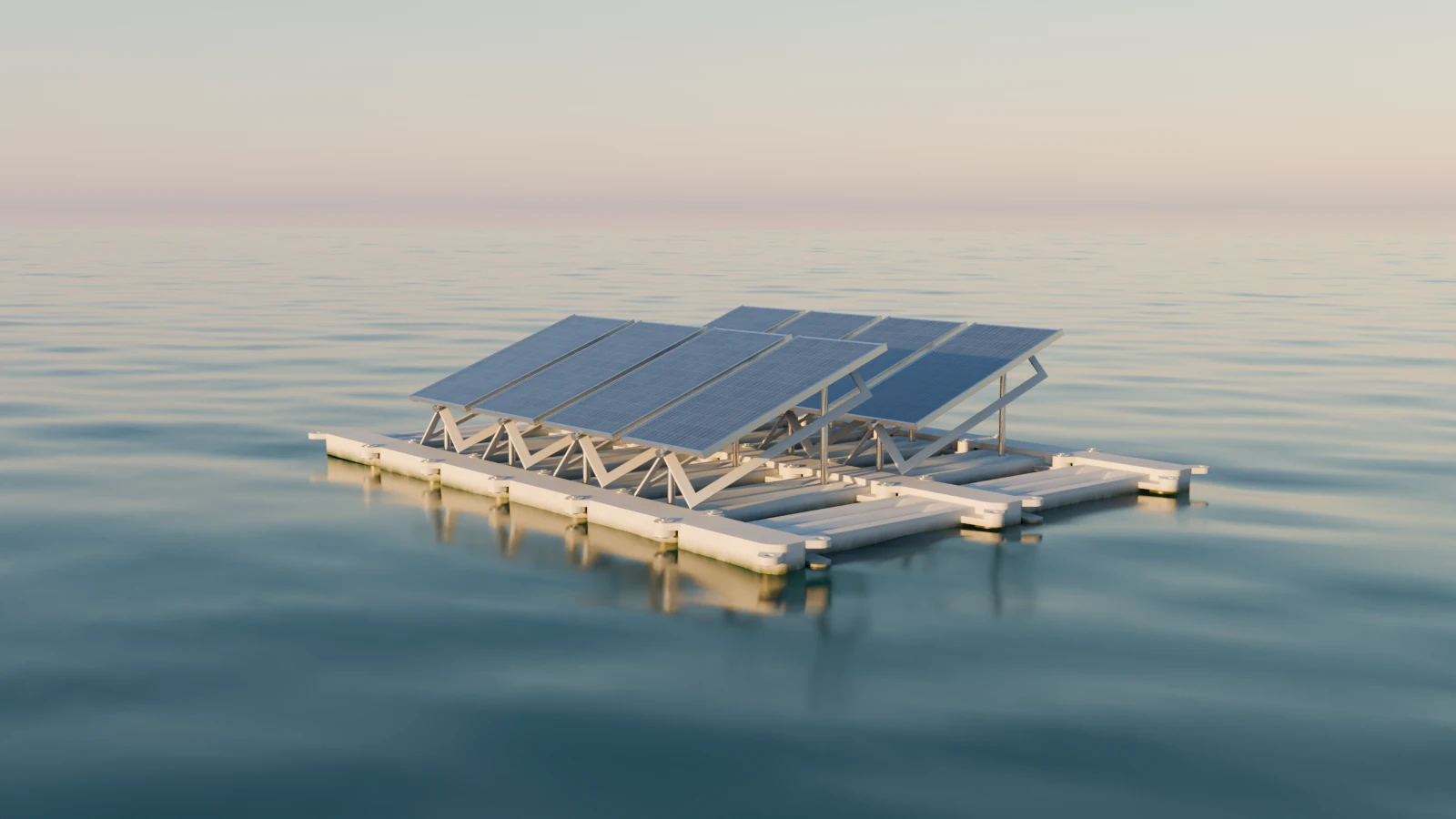
These views show a small number of modules together.
What SolarisFloat built
SolarisFloat describes PROTEVS+ as an island about 38 metres across with 180 modules, in INEGI's account of the European Inventor Award finalists. The island turns on a central buoy, pushed round by thrusters on its rim, while a drive under each module tilts it between flat and 60 degrees. An outer ring and at least eight lines hold it. The pilot that floated on a Dutch lake from 2020 was smaller, 128 to 130 modules turning on one axis (pv magazine), at a fixed 25 degrees in the TNO papers, and I found no independent record of the 180-module island in the water. Five patent families filed by SolarisFloat describe the system, and they give counts, ratios and angles but no dimensions, masses or ratings.
A reconstruction
Since no drawing is public, I rebuilt the island from the patents, the public descriptions and datasheet parts. The sizes, masses and ratings below are mine, not SolarisFloat's, and I took each one from a source, derived it or assumed it.
The 2026 reconstruction and yield studies were done with two AI agents, Claude and Codex, which wrote the Blender and simulation scripts. I set the sources and the questions and checked the results.
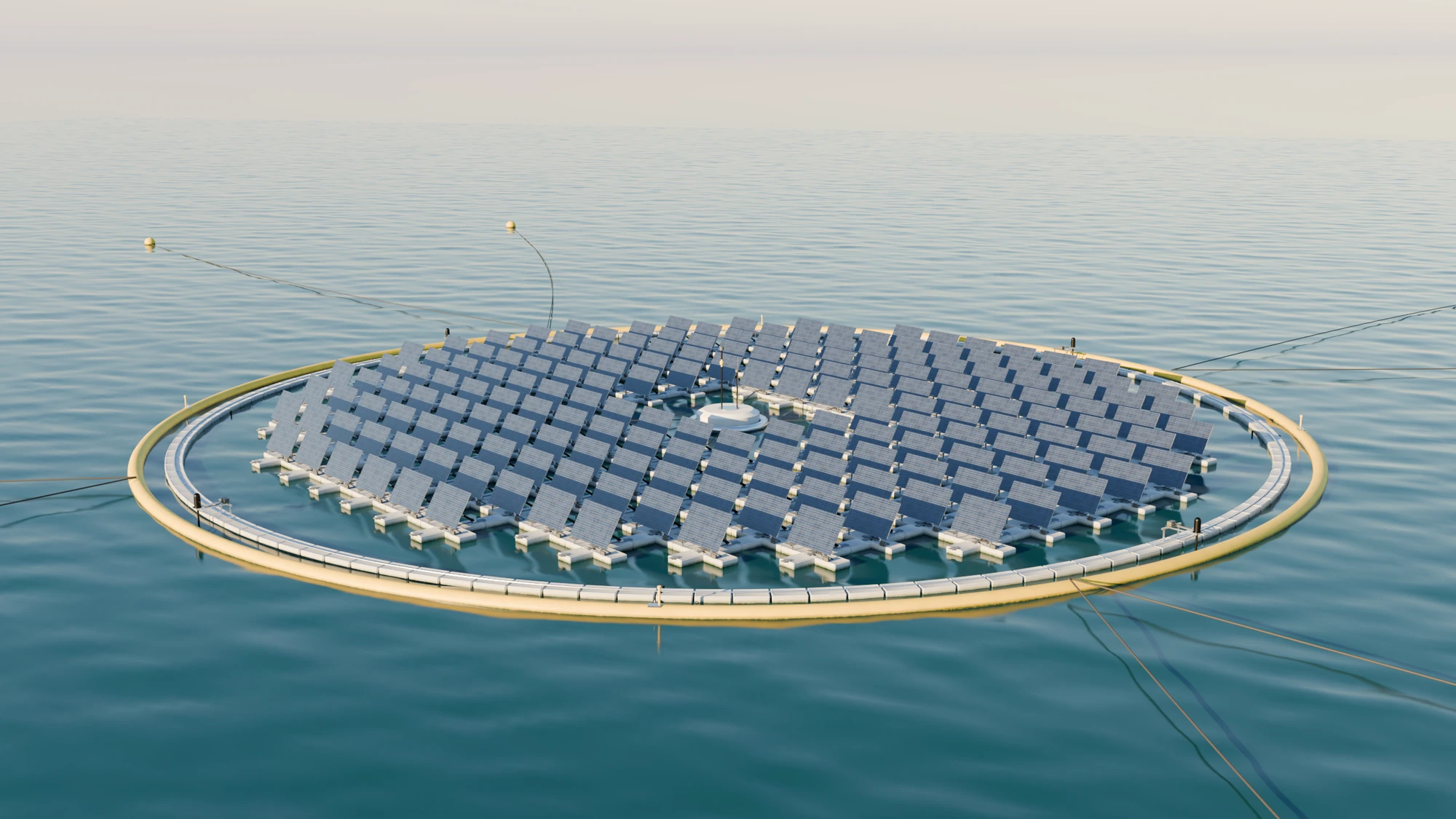

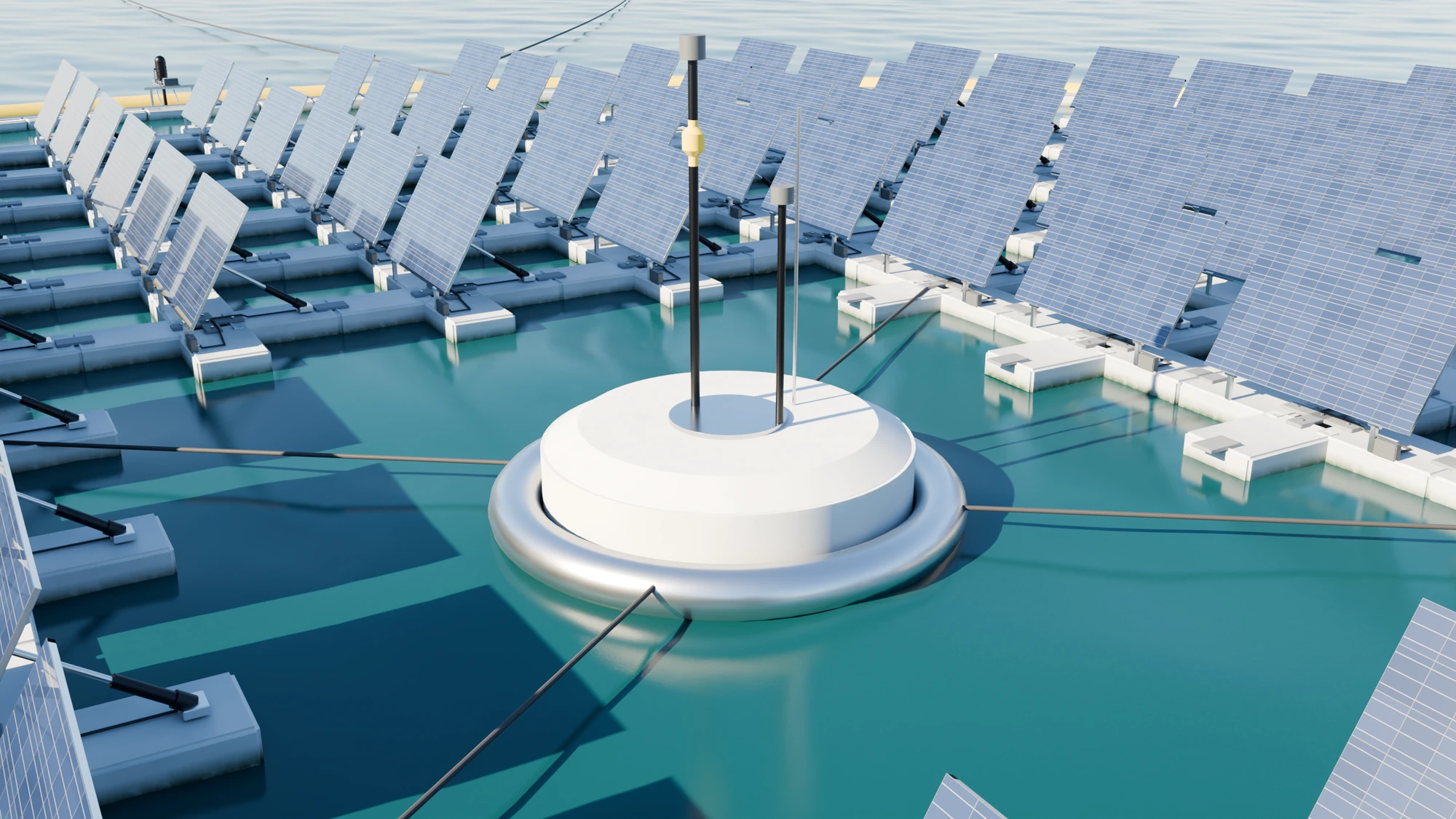
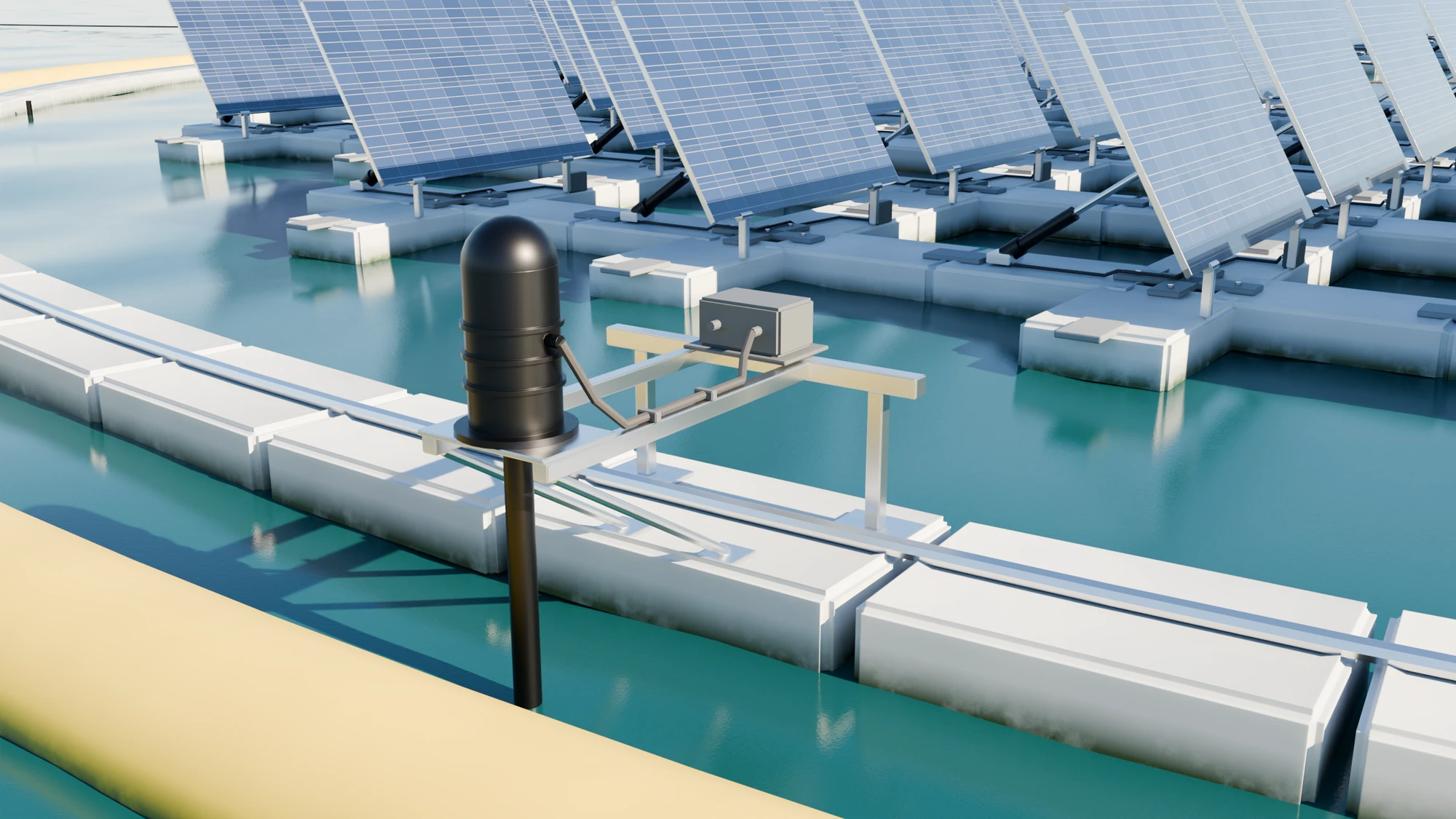
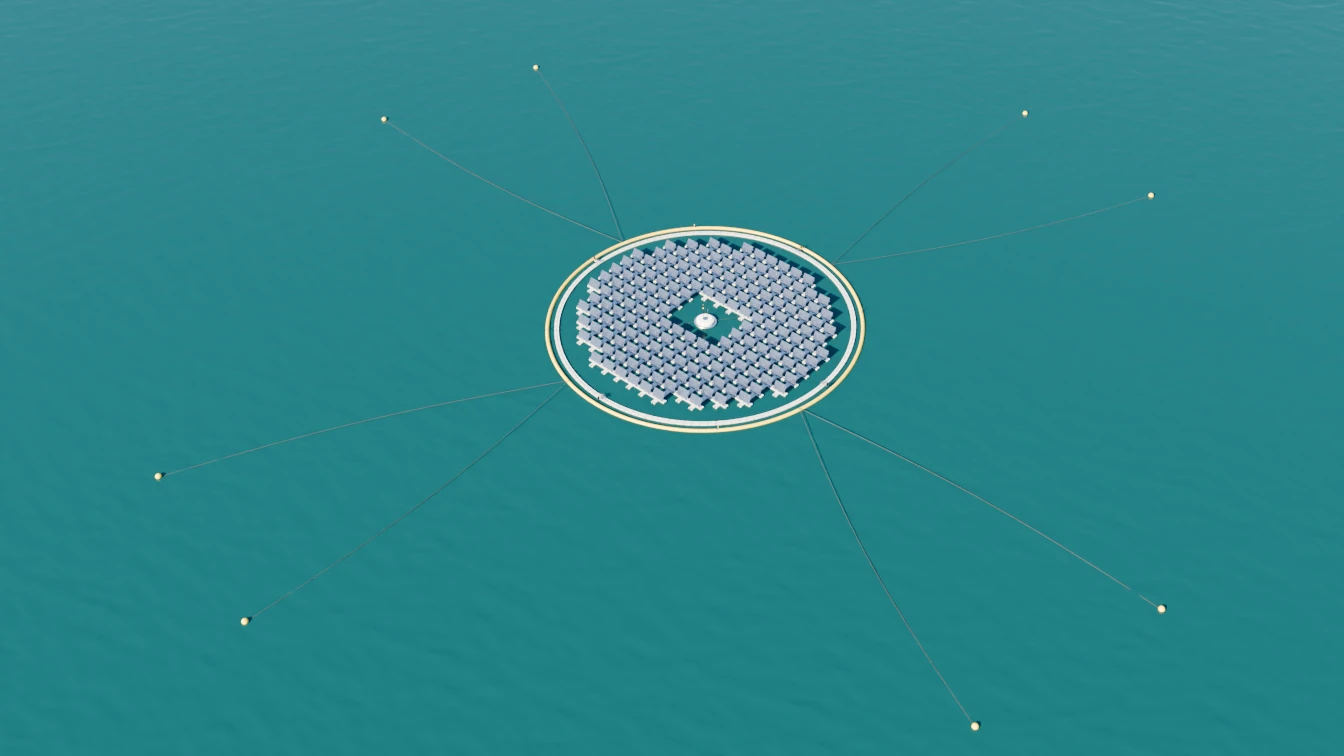
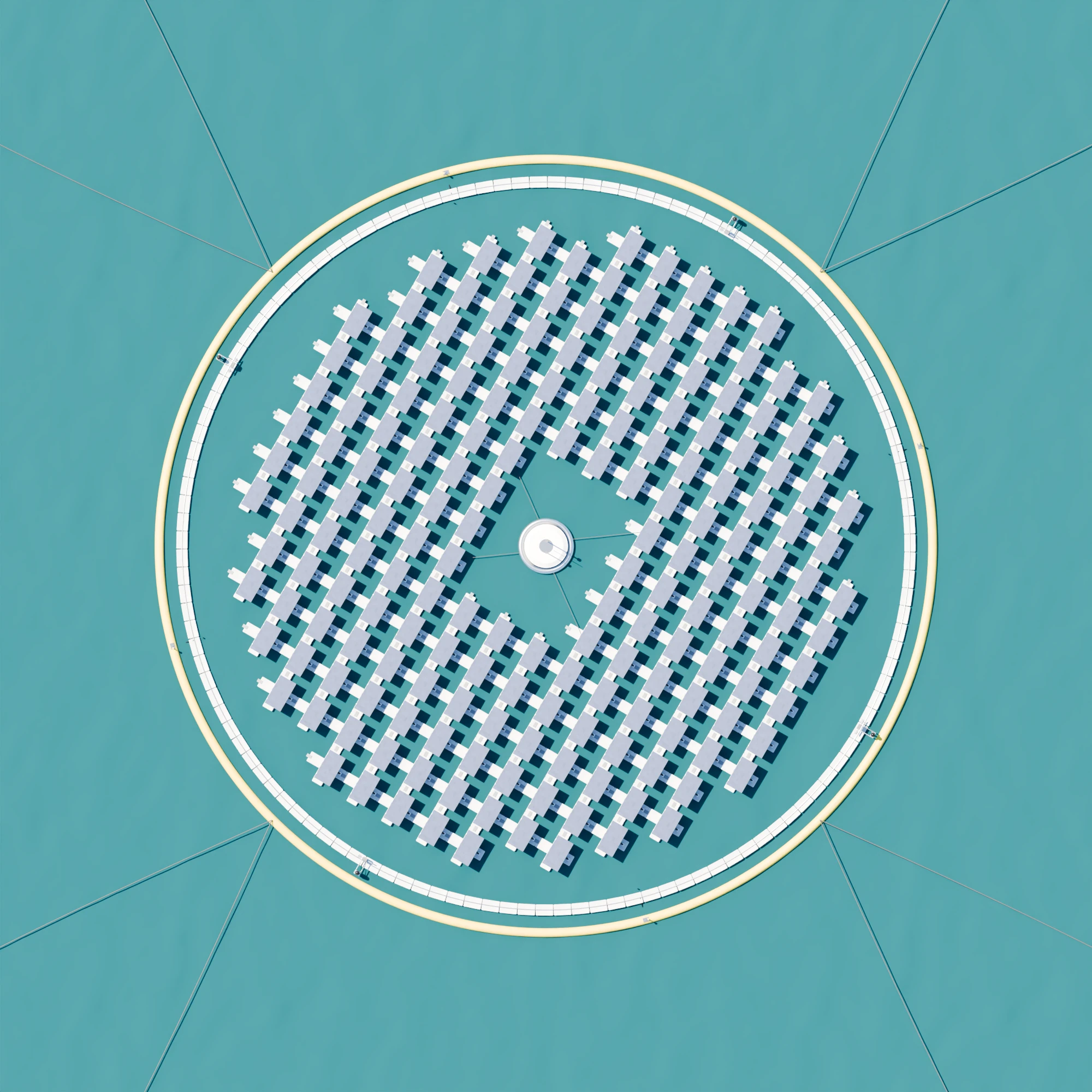
The reference island (my reconstruction)
- Panel field
- 38 m across, 180 cells on a 2.2 m grid
- Module
- 1.762 by 1.134 m, 405 Wp, 72.9 kWp in all
- Tilt
- 0 to 60 degrees, one actuator and one local controller per module
- Turning
- four 590 N thrusters on the inner ring, 19.5 m from the centre
- Moorings
- an outer ring 42.5 m across and eight lines to anchors 72 m out
- Mass
- 14.3 tonnes
Two ways to follow the sun
I drew a second concept that I liked more. In it the panels pivot all through a raft that does not turn. It is in my 2016 SketchUp model as eight panels in two rows, each hinged on its short lower edge on a V-truss frame. I expected it to give less energy and to cost more. I could test the first half.
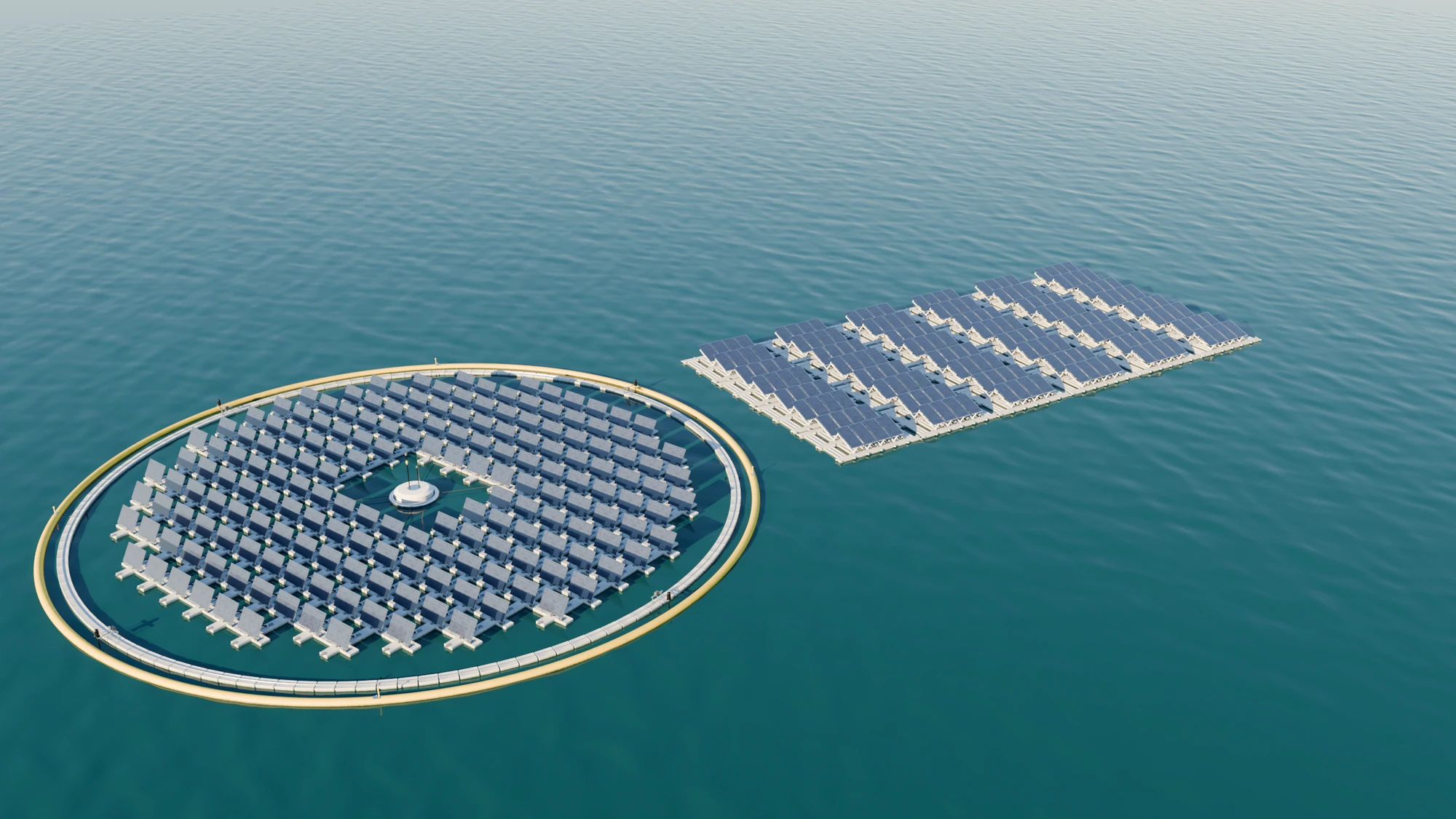
Reference island
Second concept, raft keeps its heading
Second concept, raft also turns
kWh per kWp per year
With its raft fixed, the second concept gives 1,647 to 1,761 kWh per kWp, between a seventh and a fifth less than the island's 2,042. The gap is the missing heading axis. It shrinks when the rows are spread out, because tilted panels two metres long shade each other at the model's spacing, and it closes only if the raft turns as well. What the second concept has is density: at the model's spacing it puts more energy into each square of water than the island does, and the advantage fades as the rows open up.
I could not show that the second concept costs more. It needs no thrusters, bearing, buoy or slip ring, and it carries about the same number of floats per panel, thirty for eight panels against four for one. I have no prices, so I do not know which is dearer.
What the checks show
The island with both axes gives 22% more energy than a fixed array at 30 degrees facing south on the same water, on the typical year. pv magazine and INEGI quote up to 40% more than fixed arrays. Mine is a model, not a measurement, and it is lower because diffuse light does not gain from tracking and the modules shade each other, 10 to 22% at the best pose.
To keep that pose the island turns through 110 degrees on the winter solstice and 240 on the summer one, at most 51 degrees an hour. The rim moves under five millimetres a second, so the four thrusters have far more power than turning needs. Holding the heading against the wind is what loads them. On the typical year's winds, which average 3 m/s at 10 m and never pass 9.3, that costs about 0.01% of the energy. A steady 14 m/s would cost 1 to 4% of a day's. The tilt drives and the 180 local controllers add about 0.7% of the year, taking 0.5 W for each controller at rest, which is my assumption. INEGI's figure for the motors is under 0.5%.
Stowed flat, wind from behind lifts the island's whole weight, 140 kN, at 35 m/s when nothing shelters the modules from each other. Every module therefore needs a lock that does not rely on its actuator; I assumed one, and the patents mention a blockage unit. That is a screening model with coefficients from EN 1991-1-4, not a wind tunnel.
Eight lines share a load unevenly, and the worst carries about half of it. A 30 kN mean load, with the DNV factors applied, already asks 41 kN of an anchor, just over the 40 kN of a one-tonne concrete block. Nine strings of 20 modules reach 839 V on a cold morning, above the 690 V of the slip ring I found, so the power has to cross the bearing another way: a ring rated for it, inverters on the island, or a cable loop, which works because the island never turns a full circle.
What the patents leave out
The patents do not say whether 38 metres is the field or the outer ring, whether a brake holds the heading between moves, how the island's wind load reaches the moorings, where the inverters sit and how the power crosses the bearing, or how the actuators are locked in a storm.
The weather is the PVGIS typical meteorological year for 40.63 N, 8.66 W (PVGIS 5.3, European Union). The sun is the NOAA series. The studies and renders are mine.